The Gilded Age Season 4 Episode 1 brings its characters back to the business of securing their futures, then reminds them how little a carefully negotiated arrangement can guarantee. “Ring the Bells” moves between a society wedding, an anxious household in England and a reunion that becomes far more complicated by morning. Everyone wants some measure of security. Few agree on what it should cost.
Carrie Coon and Taissa Farmiga anchor the Russell family’s crisis overseas, while Louisa Jacobson and Denée Benton give Marian and Peggy a friendship that matters beyond their respective romances. Back in New York, Christine Baranski and Morgan Spector play two powerful people whose influence cannot insulate them from family disappointment.
Oscar and Enid Make Their Partnership Official
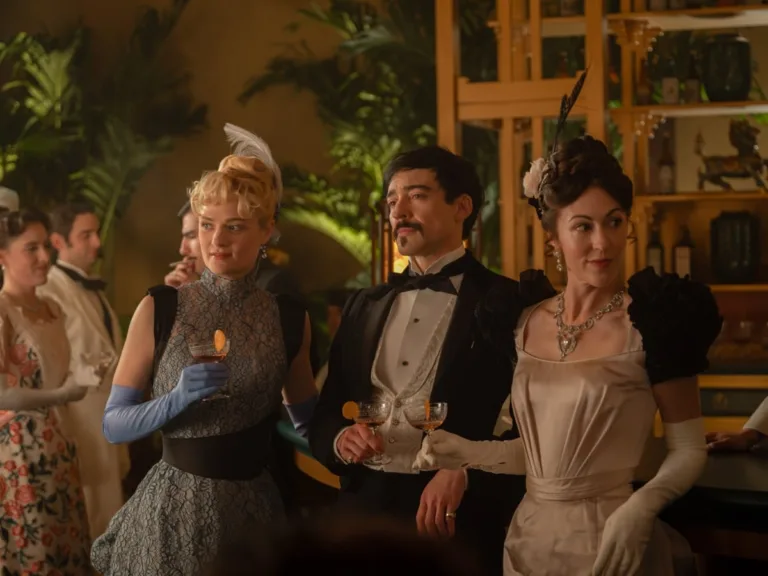
The wedding belongs to Oscar van Rhijn and Enid Winterton, whose alliance turns a shared understanding of society into a marriage. Blake Ritson and Kelley Curran make the pair entertaining because neither arrives expecting an uncomplicated love story. Oscar brings the name and connections; Enid brings money and an appetite for the world that once employed her.
For the former Turner, becoming a wealthy widow opened doors without removing every obstacle behind them. Marrying Oscar offers a different kind of legitimacy. For Oscar, the arrangement promises stability and a partner who understands that the marriage serves needs beyond romance.
Mrs. Astor’s absence makes clear that a wedding invitation cannot command every endorsement. Yet Oscar and Enid have enough enthusiasm for their own project to keep the occasion moving. Their pleasure in each other’s company gives the transaction some life. They can be calculating and still enjoy being together. They also plan to host salons for a younger social circle, imagining themselves as tastemakers rather than merely petitioners for someone else’s approval.
That is what makes the pairing useful to the premiere. This marriage begins with a degree of practical honesty that several supposedly more romantic relationships lack. The limits become visible when Enid suggests spending the night together and Oscar reminds her of their understanding. She accepts his response, but the exchange raises a question about whether their expectations are as closely aligned as their ambitions. It does not establish that either has already abandoned the arrangement.
Marian and Larry Find Their Way Back to Each Other
Marian Brook and Larry Russell arrive with their relationship unresolved. They have not spoken since Larry left for Chicago three months earlier. The attraction survives the breakup, and the wedding puts them in proximity again. An exchange of looks can acknowledge what their attempts to move forward have failed to settle.
Oscar and Enid’s downtown celebration at Webster Hall gives Marian a chance to step outside the household rules that normally organize her life. Dancing with Larry becomes a brief release from the question of what every encounter must mean. Harry Richardson lets Larry’s affection come through, while Jacobson gives Marian a happiness that feels less guarded than usual.
A storm then interrupts the journey home, stranding the pair and sending them to a hotel. They initially take separate rooms. When Larry comes to Marian’s door, she invites him inside, and they spend the night together.
The distinction matters: the evening brings them physical intimacy without first repairing their engagement. Desire has brought them together more quickly than they can agree on a future. The scene can therefore feel romantic in the moment while leaving a serious uncertainty waiting for them.
Why Marian Panics the Next Morning
Morning changes Marian’s understanding of the night. She fears that she has compromised her reputation and her prospects, and that fear overwhelms Larry’s efforts to reach her. He experiences her distress as rejection, although the social danger she imagines is not one they share equally.
In an interview with Decider, Jacobson explained Marian’s panic through that imbalance: she believes the encounter could change her entire future, while Larry would not face the same consequences. That reading helps explain the abrupt shift from the previous night’s freedom.
Marian is trying to reconcile what she wanted with everything she has been taught about the kind of woman she should be. The aunts’ concern with appearances only reinforces the pressure. The premiere does not resolve that conflict by having Larry offer reassurance and Marian immediately accept it.
Peggy provides the gentler response when Marian begins to confide in her. Marian describes an inappropriate kiss without revealing the full encounter. Peggy listens without treating her friend as a ruined person, although she has not been given the whole story. Their conversation gives Marian somewhere to bring the fear that she cannot comfortably share at home, and it gives the episode a welcome pause from judgment.
The storyline’s strength lies in the gap between the two lovers’ experiences. Its challenge going forward will be making their conversations as convincing as their attraction. This night has changed things, but it has not restored their engagement.
Gladys’s Delivery Puts Bertha’s Ambitions Aside
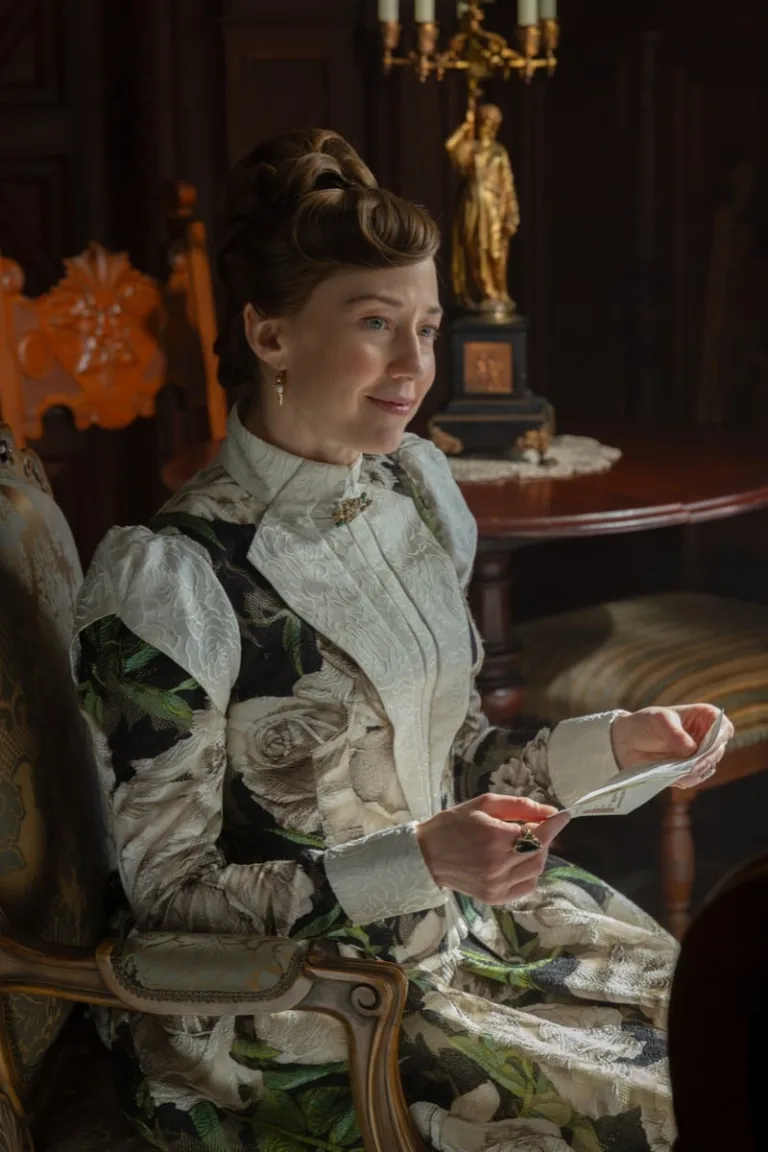
In England, Gladys faces a difficult delivery with Bertha at her side. The crisis strips away the protections that money and position usually seem to offer. Bertha can insist, argue and remain present, but she cannot negotiate her daughter out of danger.
The baby is breech, and Hector is confronted with the possibility that the doctor may be unable to save both his wife and their child. Bertha argues for Gladys; Hector’s sister, Lady Sarah, argues for the baby. Hector chooses Gladys. The decision speaks to how their relationship has developed since the arrangement that brought them together, particularly in a household where producing an heir carries such weight.
Gladys delivers a son, but severe bleeding creates another emergency. The doctor saves her by removing her uterus. She survives, as does the baby, but she will not be able to have more children.
Bertha and Hector know what has happened before Gladys does. Bertha advises waiting until her daughter is stronger before telling her. The immediate relief therefore carries a secret that the people around Gladys are deciding how to manage.
There is tenderness in seeing Bertha concentrate on her daughter’s survival. Coon gives that urgency a different texture from Bertha’s familiar determination to secure an advantageous outcome. Yet the decision to delay the truth also exposes an old habit: even while trying to protect Gladys, Bertha helps decide what she should know about her own life.
The episode leaves room to understand the impulse without treating it as a settled solution. Gladys has already had major decisions made around her. Surviving this ordeal should give her a future to shape, and that future now includes information she has not received.
George’s Anger Reaches Beyond His Separation
George and Bertha remain apart, and the premiere gives them no shared scene to soften that distance. The attempt on George’s life continues to weigh on him, while business pressures and family resentment make his interactions increasingly harsh. Competition from John D. Rockefeller and the threat of legislation from President Cleveland give his financial anxieties a concrete basis. When Bertha prepares to return from England, George plans to move out rather than share their home.
Larry receives some of that anger. George’s treatment of his son suggests a man whose frustration no longer stays within the boundaries of the problem that provoked it. He has plenty to be furious about, but the people near him cannot repair all of it simply by absorbing his temper.
News of his grandson’s birth provides a welcome development, but it does not repair the family’s divisions. George’s continuing resentment over Gladys’s marriage remains part of that distance. His response cannot be reduced to uncomplicated celebration when he is still refusing to reconcile with Bertha.
The Pinkertons’ investigation supplies movement in the search for whoever tried to kill him. The detectives have located the shooter, an unidentified man living in a tenement with a woman George finds familiar. That is a substantial breakthrough, but recognizing something about the pair is not the same as explaining who ordered the attack. The episode leaves those wider answers open.
Finding someone to blame may offer George a concrete objective. It cannot by itself settle his marriage or restore the confidence his family once had in one another. That difference keeps the investigation connected to his emotional state without pretending it explains everything.
Peggy Has Good News—and an Overbearing Future Mother-in-Law
Peggy reaches a publishing milestone with her book, Friends In These Times, while preparing for her marriage to Dr. William Kirkland, played by Jordan Donica. Their happiness gives the premiere an affectionate relationship that does not immediately collapse under its own complications. However, William mentions wanting children sooner rather than later, and Peggy does not appear equally eager. That difference opens a conversation they need to have; it is not proof that their marriage is already doomed.
Elizabeth Kirkland remains a complication all the same. She appears to have shifted from opposing the match to influencing its terms. Her gestures of inclusion come with the familiar feeling that Peggy’s life is being arranged around someone else’s expectations.
The invitation for Peggy and Dorothy to join the Daughters of Friendship could create a meaningful connection. Elizabeth’s dismissive response to Peggy’s excitement about her book makes it harder to accept the gesture without reservation.
Peggy’s professional achievement deserves attention in its own right. The tension is effective because it concerns recognition as much as approval: being welcomed as a prospective daughter-in-law is not the same as having her work valued. Her friendship with Marian offers a more generous exchange, with each woman able to speak as herself.
Agnes Plans a Presidential Reception as Jack Learns Society’s Rules
Agnes prepares to host President Grover Cleveland, but Ada resists further spending after Peggy draws attention to his politics. The disagreement makes the prospective reception another negotiation over who controls the household’s money and what that money should support.
Armstrong then tells Agnes that Enid was once Turner, Bertha’s lady’s maid. Enid does not deny it when confronted. Instead, she offers financial help, including support for the presidential dinner. Agnes must weigh her objection to Enid’s background against the assistance her new daughter-in-law can provide.
It is an economical reminder of the household’s changed balance. Agnes retains formidable social authority, but authority does not pay for every ambition. Money keeps forcing negotiations that old certainty once allowed her to avoid.
Jack, meanwhile, discovers that financial success has not automatically taught him how to move through the company it brings. His new mixing-machine invention has given him another opportunity, but selling it also requires navigating business circles where education and table manners become tests of belonging. His struggle with an artichoke becomes a comic expression of a real insecurity.
Bannister and Jack’s former co-workers help him practice the rules, with Bridget joining him for a dance. Their warmth makes his old workplace a place of support rather than embarrassment. Bridget nevertheless worries about the distance opening between Jack’s new opportunities and the people he has known. Her concern is not evidence that he has already abandoned them. It is the fear that a changing life could eventually ask him to.
These smaller scenes keep social advancement from becoming an abstract theme. For Enid it means negotiating an awkward revelation; for Agnes it means accepting assistance; for Jack it means wondering whether success requires becoming someone his friends would struggle to recognize.
The Gilded Age Season 4 Episode 1 Ending Explained
The bells celebrate the arrival of the Buckingham heir. Gladys and her son are alive, and Bertha tells her that Hector chose to save her when faced with an impossible decision. The moment gives Gladys reassurance about her husband’s feelings.
It is also an incomplete account of the ordeal. Gladys does not yet know about the operation or that she cannot have another child. The ending therefore combines a public celebration with a private truth still being withheld.
Elsewhere, the premiere offers progress without closure. Marian and Larry have crossed a new boundary without agreeing on what comes next. Peggy has reason to celebrate alongside reason to remain cautious. George’s detectives have located his shooter while his family remains fractured.
“Ring the Bells” uses those unfinished conversations to launch the season. The characters have survived immediate crises or secured important opportunities, but they still need to decide how honestly they will deal with one another afterward.
Final Verdict
The Season 4 premiere is strongest when a grand event gives way to a difficult personal exchange. Marian’s conversation with Peggy and Bertha’s presence beside Gladys make the consequences of society’s expectations tangible. Oscar and Enid supply welcome energy, and the household comedy keeps the hour from becoming uniformly anxious.
Repeated romantic misunderstandings and another consequential secret could become frustrating if they linger without development. For now, “Ring the Bells” establishes compelling problems for its ensemble: finding affection inside an arrangement, asserting independence within a family and deciding whether protection can justify withholding the truth.
Celebrations Open the Door to Difficult Conversations
An emotionally busy premiere gives its romances and family struggles fresh urgency, even as familiar misunderstandings threaten to return.
The contrast between public celebration and the private fears it cannot resolve.
Louisa Jacobson’s shift from Marian’s brief freedom to her morning panic.
Peggy’s compassion, Bertha’s maternal urgency and Oscar and Enid’s lively partnership.
Another withheld truth and the risk of repeating Marian and Larry’s romantic impasse.
Frequently Asked Questions
What is The Gilded Age Season 4 Episode 1 called?
The premiere is titled “Ring the Bells” and debuted November 1, 2026.
Do Gladys and her baby survive?
Yes. Gladys delivers a son and survives a subsequent hemorrhage, but the doctor removes her uterus to save her. She has not yet been told she cannot have more children.
Are Marian and Larry engaged again?
No. They spend the night together after a storm strands them at a hotel, but they do not renew their engagement.
Who gets married in the premiere?
Oscar van Rhijn marries Enid Winterton, formerly known as Turner.
Is George’s attempted assassination fully solved?
No. The Pinkertons have located the shooter, but the episode does not fully explain who commissioned the attack.
Where to Watch The Gilded Age
The Gilded Age airs Sundays at 9 p.m. ET/PT on HBO and is available to stream on HBO Max. Season 4 contains eight episodes. See our Season 4 premiere photos for another look at “Ring the Bells.”
What did you think of the premiere? Share your thoughts on Marian and Larry, Oscar and Enid, and the Russell family’s next chapter in the comments.

Thomas Miller is the founder and Editor-in-Chief of Seat42F, covering television, movies and streaming entertainment. He launched Seat42F in 2007 and has spent nearly two decades covering the entertainment industry.