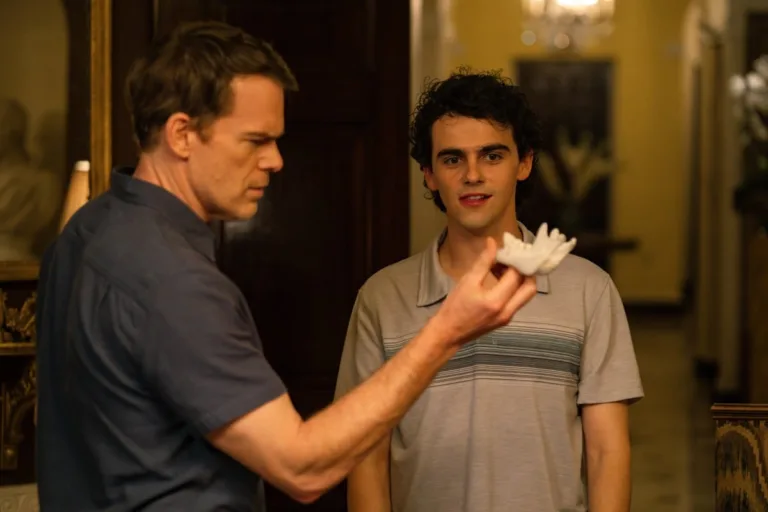
Dexter: Resurrection Season 2 Episode 4 gives Dexter Morgan a young man who might have become Harrison under different circumstances. “Young Blood” asks him to distinguish an inherited appetite for violence from the damage inflicted by a murderous father. By the end, Dexter has made a decision about his target, but his own son is bringing the same question much closer to home.
Spoiler Warning
This recap reveals JJ’s identity and fate, the Five Borough Killer’s latest attack, Charley’s departure and the episode’s final cliffhanger.
The Inheritance Dexter Should Refuse
JJ’s arrival gives Dexter a reason to question his influence on Harrison, just as his son begins asking for the wrong kind of help.
JJ’s relationship with his father makes Dexter confront the difference between protecting a son and recruiting one.
Harrison’s offer to help turns his growing faith in Dexter into a problem Dexter helped create.
Charley’s departure makes the temptation to accept Harrison’s support more personal and more dangerous.
JJ’s confession resolves the hardest part of Dexter’s moral dilemma before he has to make a truly uncertain choice.
Michael C. Hall’s Dexter has found a useful partner in Uma Thurman’s Charley. Their remaining business with Prater’s circle should be straightforward: draw out Jawsplitter and finish the list. Instead, Jack Dylan Grazer’s JJ arrives in place of the older killer they expected. Jack Alcott’s Harrison is working through a parallel problem at the NYPD, where making an arrest does little to restore his confidence that the worst offenders can be stopped.
Jawsplitter’s Son Changes the Assignment
The original Jawsplitter is already dead. JJ has inherited both his invitation and his murderous identity. Dexter cannot simply treat him as an interchangeable replacement. A father who introduces his child to killing has created a victim as well as a possible successor, and Dexter knows too much about that arrangement to dismiss it.
He takes time to assess JJ, spending the day with him in New York and asking about his upbringing. The outing gives Dexter a chance to investigate without immediately imposing a verdict. It also lets JJ experience attention from an older killer who seems interested in him. Their conversation carries an ugly imbalance: the apparent welcome is an assessment of whether he deserves to die.
Dexter has reason to recognize the danger of making a child’s identity revolve around a parent’s violence. Harry supplied the rules that shaped his life, and Dexter tried to build a comparable bond with Harrison. JJ makes that history difficult to keep at a comfortable distance. Dexter’s concern is partly about what happened to this young man and partly about what he himself has done as a father.
JJ ultimately reveals that he killed his father and keeps his jaw as a trophy. His account establishes an active commitment to the killings rather than reluctant participation in somebody else’s legacy. Dexter decides that JJ meets the Code and kills him.
That confession resolves the immediate decision while softening the episode’s challenge. Dexter no longer has to act with the same uncertainty about JJ’s choices. The more troubling question survives, however: how much responsibility does a father retain when the child he has encouraged begins wanting this life for himself?
Harrison’s First Arrest Comes With a Warning
Harrison and Fiona Mixon are assigned to the subway as police respond to another threat from the Five Borough Killer. Harrison spots a purse snatcher and pursues him, asking Fiona to stay behind. The chase ends with Harrison in danger and Fiona intervening. They make the arrest, but the achievement depends on the partner he tried to leave out.
Nona Parker Johnson’s Fiona has a practical place in Harrison’s story beyond their personal history. She is someone whose judgment he needs to trust. His determination helps him act, but it does not make him self-sufficient. The episode gives him a legitimate success while leaving room to question the decisions that got him there.
That distinction matters when Harrison later evaluates his father’s methods. Police work requires cooperation and limits; Dexter offers the promise of a result when those limits feel intolerable. Harrison’s impatience is understandable. His conclusion is much more dangerous.
The Five Borough Killer Turns Police Protection Into a Taunt
Claudette Wallace and Melvin Oliva learn that the phones used by the Five Borough Killer were purchased years earlier. The discovery suggests preparation extending well beyond the current attacks, without giving them an easy route to the person making the calls.
The subway threat produces a heavy police presence, yet the killer still gets a victim. A death initially read as an overdose is revealed to be murder. The subsequent video, delivered by AirDrop to the police, shows how close officers were to what they failed to recognize. The attack damages the department’s authority as well as taking another life.
Kadia Saraf’s Wallace keeps pursuing the evidence rather than accepting the convenient explanation. Her persistence is important to the episode’s argument. The police are struggling, but the story still contains people doing the necessary work. Harrison’s frustration risks flattening their effort into proof that only Dexter can make a difference.
Charley Leaves, and Quinn Keeps Looking
Finishing the Jawsplitter business means something different to Charley than it does to Dexter. He wants to extend the connection; she is ready to leave New York. Her departure ends the partnership’s immediate purpose without fulfilling the companionship he has begun to imagine.
Dexter’s loneliness gives the coming conversation with Harrison an additional pressure. A son offering understanding can seem especially welcome after another potential partner walks away. That makes Dexter’s response emotionally coherent, but it should also make him more cautious. Harrison cannot safely become a substitute for the adult relationship Dexter hoped to have.
Elsewhere, Desmond Harrington’s Quinn continues moving through Prater’s world and has contact with Charley. Batista’s hat among the evidence gives his investigation a connection to a loss that already matters. Quinn has not conclusively exposed Dexter here, but his proximity to the people and material surrounding him remains a threat.
“Young Blood” Ending Explained: Harrison Reopens the Ripper Hunt
Harrison’s anger over the killers escaping justice changes his position on Don Framt. He now supports Dexter going after the New York Ripper and offers to help. Brian Cox’s Framt continues to make the victims’ suffering part of his gratification, giving Harrison a target around whom that frustration can gather.
Dexter accepts the opening despite the warning JJ’s story has just supplied. The Code may remain intact as a rule for choosing victims, but that does not answer whether involving Harrison is defensible. A justification for killing is becoming a justification for drawing his son back toward it.
The final knock introduces another uncertainty. Dexter opens his door and reacts to someone he believed was dead. The visitor is not shown, so the episode does not establish their identity. A familiar character’s possible return is a hook for the next installment rather than a reveal this recap can settle.
“Young Blood” is most effective when it lets the two father-son stories argue with each other. Dexter recognizes a destructive inheritance in JJ, then struggles to refuse a version of it in his own home. Resolving the weekly target so firmly limits the ambiguity, but Harrison’s invitation leaves the deeper conflict open. Dexter can follow his rules and still make a terrible decision about his son.
“Young Blood” FAQ
Who is JJ?
JJ is Jawsplitter’s son, played by Jack Dylan Grazer. He has taken over his father’s identity and continued killing.
Does Dexter kill JJ?
Yes. After learning about JJ’s murders and his killing of his father, Dexter decides he fits the Code.
Does Harrison make his first arrest?
Yes. He pursues a purse snatcher, but needs Fiona’s intervention when the chase turns dangerous.
Does Charley leave New York?
Yes. With their work on Prater’s remaining killers complete, she prepares to leave.
Who is at Dexter’s door?
The episode withholds the visitor’s identity. Dexter’s reaction indicates he believed the person was dead.
Where to Watch Dexter: Resurrection
“Young Blood” premiered Friday, November 20, 2026, on Paramount+ Premium in the U.S. New episodes premiere Fridays. See the official Season 2 episode guide for available installments.
More Dexter: Resurrection Coverage
Read our Season 2 Episode 3 recap or explore all Seat42F Dexter: Resurrection coverage.

Thomas Miller is the founder and Editor-in-Chief of Seat42F, covering television, movies and streaming entertainment. He launched Seat42F in 2007 and has spent nearly two decades covering the entertainment industry.