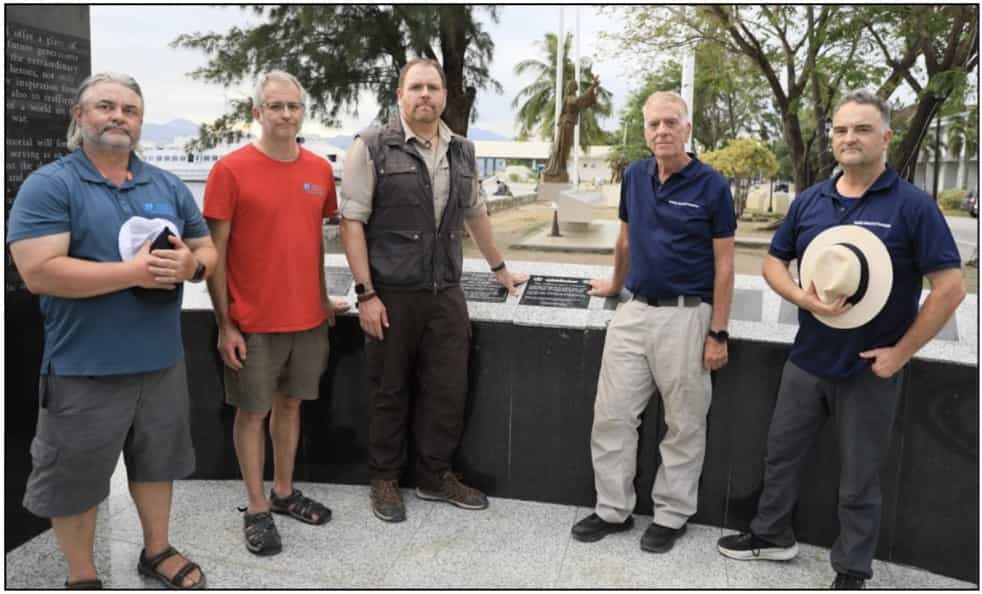
More than 80 years after it vanished beneath the waters off the Philippines, the wreck of the infamous World War II Hellship Hōfuku Maru has finally been identified. The groundbreaking discovery was made by explorer Josh Gates, The Hellships Memorial Foundation, and a team of maritime experts, bringing long-overdue recognition to one of the war’s most tragic and overlooked stories.
The Hōfuku Maru was one of the Japanese prison transport vessels known as “Hellships,” cargo ships and passenger liners repurposed during World War II to transport Allied prisoners of war between forced labor camps throughout Asia. Conditions aboard these vessels were notoriously brutal, with overcrowding, disease, starvation, and abuse claiming thousands of lives. Of the more than 125,000 Allied POWs transported aboard Hellships during the war, an estimated 20,000 never survived the journey.
On September 21, 1944, the Hōfuku Maru was traveling as part of a Japanese convoy when it was struck by an Allied torpedo. Unaware that prisoners were being transported aboard the vessel, Allied forces targeted the convoy as a military operation. The ship reportedly split in two and sank in less than three minutes, taking as many as 1,000 British and Dutch prisoners with it.
For decades, the ship’s final resting place remained a mystery.
That changed when retired U.S. Naval Officer Randy Anderson and The Hellships Memorial Foundation uncovered previously overlooked American and Japanese military records suggesting the Hōfuku Maru had sunk more than 30 miles from its commonly accepted location. The discovery prompted a new search effort led by Gates and a team that included underwater imaging specialist Evan Kovacs and maritime archaeologist Dr. Calvin Mires of Marine Imaging Technologies.
Using advanced sonar technology, the team located an unidentified wreck more than 160 feet beneath the surface off the coast of Luzon in the Philippines. Subsequent dives revealed key structural details that matched historical blueprints of the Hōfuku Maru, including the ship’s size, cargo hold configuration, mast placement, and the fact that the wreck had been violently split into two sections — precisely matching wartime accounts of the sinking.
The expedition also uncovered human remains at the site, underscoring the wreck’s significance as a wartime grave and a final resting place for hundreds of Allied servicemen.
“The pieces all fit,” researcher Tim Beckensall said. “The vessel is the right size, in the right place and from the correct period. I am convinced this is the Hōfuku Maru.”
For Gates, the discovery represents more than a major archaeological achievement.
“The story of the Hellships is a chapter in the history of WWII that demands to be brought to light,” Gates said. “The research and dives that led to this groundbreaking discovery can hopefully offer closure to the families of more than a thousand servicemen who made the ultimate sacrifice.”
The remarkable search for the Hōfuku Maru will be featured in the two-part season premiere of EXPEDITION UNKNOWN, titled Hunt for the Hellships. The special will also highlight the work of the Defense POW/MIA Accounting Agency (DPAA) as they continue efforts to recover and identify remains from another infamous Hellship, the Ōryoku Maru, which sank in Subic Bay during the war.
Tune In
The two-part season premiere of EXPEDITION UNKNOWN: Hunt for the Hellships premieres Wednesday, June 24 at 9:00 PM ET/PT on Discovery Channel.
Viewers can join the conversation on social media by using #ExpeditionUnknown, and following Discovery on Facebook, X, Instagram, and TikTok and Expedition Unknown on Facebook and Josh Gates on Instagram, X, and TikTok.
EXPEDITION UNKNOWN is produced for Discovery Channel by Ping Pong Productions.

Thomas Miller is the founder and Editor-in-Chief of Seat42F, covering television, movies and streaming entertainment. He launched Seat42F in 2007 and has spent nearly two decades covering the entertainment industry.