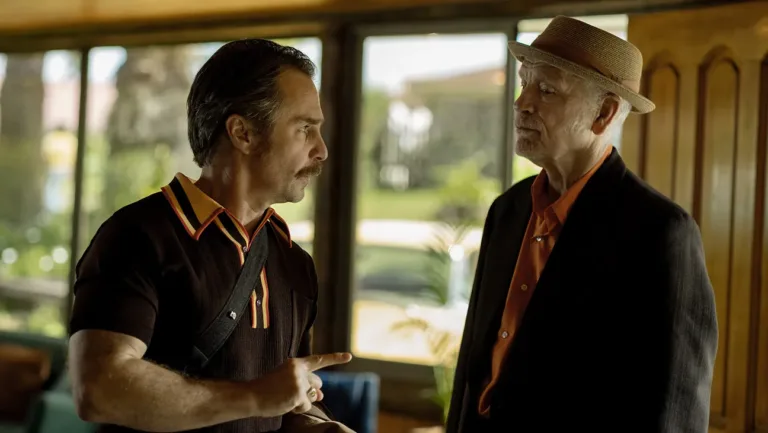
Wild Horse Nine builds its best joke around the one skill a spy cannot afford to lose: knowing when to stop talking. John Malkovich plays an aging CIA operative who treats state secrets like stories he’s been saving for the right dinner party. Sam Rockwell plays the man who has to sit next to him. The pairing is funny on its own, but the reason to see Martin McDonagh’s dark comedy is what happens when keeping an old friend company starts to feel like the last decent thing either man knows how to do.
Malkovich’s Chris and Rockwell’s Lee are stationed in Santiago in 1973, shortly before the Chilean coup, when bureau chief MJ (Steve Buscemi) sends them to Easter Island. Chris strikes up a friendship with two student activists, played by Mariana di Girolamo and Ailín Salas. For the Americans, the island offers a change of scenery. For the students, the politics the agents discuss so casually will determine what kind of country they come home to.
SEAT42F SNAPSHOT
Two Spies, One Very Bad Vacation
A rueful black comedy about friendship between men who’ve spent their lives making excuses for each other.
Standout: Malkovich’s impish Chris, with Rockwell doing the quieter work of making their history feel lived in.
The tradeoff: The friendship is more convincing than Chris’s moral reckoning, and the pacing is uneven.
John Malkovich Gets the Laughs. Sam Rockwell Makes Them Hurt.
Chris is ill, his memory is getting unreliable, and the agency has reason to worry about what he might say in public. The lively question in Malkovich’s performance is how much Chris still knows about the effect he has on a room. A man can lose his train of thought and still know precisely which remark will make his friend squirm. That uncertainty keeps Chris interesting long after the joke about an indiscreet spy should have worn out.
Lee has the less enviable job of keeping the conversation on the rails. The temptation with Rockwell would be to give him the same license to riff, but making him the one who has to listen gives their scenes a better rhythm. You get the sense Lee has heard some of these stories enough times to know where he’ll have to interrupt. It’s an ordinary feature of a long friendship, made uncomfortable by what passes for an anecdote in this one.
The dialogue also lets each man take the other’s measure. In an exchange from the trailer, Chris names a country where he claims to have killed someone, and Lee is sure he picked it just because Lee can’t spell it. What sounds like a boast to a stranger sounds like a very old insult to Lee. As IGN’s review points out, McDonagh also brings small lines back later as callbacks. The conversations can sound as if they’re wandering even while the script is laying track.
Buscemi’s MJ gives the operation the air of an office nobody wants to be in. It helps that McDonagh is willing to let the men fuss over trivial things while their actual business is appalling. A conversation about cheese can be funny because the subject is so small, then become unnerving when you realize the same men can talk about the fate of a country with much the same degree of concern. Parker Posey, as Lee’s wife Margie, brings some of that comic friction into his home life, where his patience is hardly more useful than it is at work.
The Island Gives the Film Room to Breathe
Anyone who has seen In Bruges will recognize the setup: two men in a violent line of work, stuck sightseeing in a beautiful place while an assignment hangs over them. WBUR’s Sean Burns sees the resemblance as central to the film. The repetition is real, but the change of setting matters. Bruges was a place its visitors couldn’t agree on how to enjoy. Here the moai and the island’s open spaces make the Americans seem small, however much influence they carry back in Santiago.
Rapa Nui also lets McDonagh borrow the posture of a Western: Chris can wander through an open landscape and imagine himself a man with nobody to answer to. The moai complicate that fantasy. They belong to a history much older than the one he likes to tell about himself, and they give his boasts a different scale. The setting also makes it harder to ignore who gets to leave. Chris and Lee can talk about Chile as a posting. The students have to think about it as home. Di Girolamo’s Monica gives the film its clearest point of resistance to Chris. Lee knows when to let an old story pass; Monica has no reason to indulge it. That makes their encounters more revealing than another conversation between men who have agreed for years on what counts as necessary. The limitation is that the story keeps circling back to what those encounters do for Chris. As much as the students sharpen the argument, it’s the Americans who get most of the room to contradict themselves.
Cinematographer Ben Davis gives the trip a visual rhythm of its own. Footage styled after Lee’s Super 8 camera makes the island look like something a visitor could take home in a reel of vacation film. The wide shots give the moai room in the frame, while closer views of the men gradually narrow the story to what they owe each other. The photography is most useful in that shift in scale: we can see how far they’ve traveled and how little distance they’ve put between themselves and their work.
That imbalance is especially noticeable when Chris starts asking what might be left for him after a lifetime of doing the agency’s work. His Catholic questions about guilt and forgiveness give the movie a more intimate subject than the conspiracy setup promises. They also raise the uncomfortable possibility that he wants absolution more urgently than he wants to understand the damage he helped cause. Rockwell’s tenderness toward him doesn’t settle the question, and the film is more interesting whenever it lets that discomfort sit. IndieWire’s Venice review is less persuaded by Chris’s change of heart, and there’s a useful distinction there: it’s easy to believe that Lee loves this man and harder to believe that Chris is prepared to reckon with what he did. His failing memory makes that distinction sharper. The very things he may want to forget are what the agency wants kept quiet.
Is Wild Horse Nine Worth Seeing?
Yes, especially if you like McDonagh’s ear for a conversation that starts out petty and ends up somewhere painful. Viewers hoping for a tightly plotted espionage thriller may find the detours frustrating. The first half takes its time finding a rhythm, and the movie gets busier once it has to make good on the danger in its setup. The change leaves less space for the uneasy silences that make the island scenes work. The movie has more patience for a conversation about the afterlife than it does for explaining the mechanics of a covert operation. The laughs and the friendship are persuasive enough to make that a worthwhile bargain, even if the political story leaves you wanting a wider view.
The film has already picked up Gotham nominations for McDonagh’s original screenplay and Malkovich’s lead performance. Malkovich is the obvious draw, but the casting works as well as it does because Rockwell leaves him space. The quieter performance makes you believe there was a friendship here before the film began, which is why the idea of it ending carries any weight at all.
Where to Watch Wild Horse Nine
Wild Horse Nine opens in U.S. theaters Friday, November 6, 2026, from Searchlight Pictures. Visit the official film page for the trailer and showtimes.
Wild Horse Nine FAQ
Who directed Wild Horse Nine?
Martin McDonagh wrote and directed the film.
How long is Wild Horse Nine, and what is it rated?
It runs 1 hour and 58 minutes and is rated R for strong violence, pervasive language, drug use and sexual references.
Is Wild Horse Nine streaming?
Searchlight has announced a November 6 theatrical release. A streaming premiere date has not been announced.

Thomas Miller is the founder and Editor-in-Chief of Seat42F, covering television, movies and streaming entertainment. He launched Seat42F in 2007 and has spent nearly two decades covering the entertainment industry.