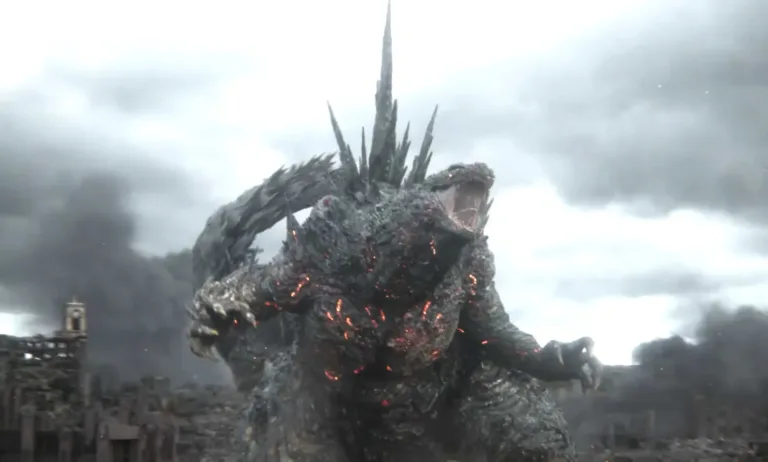
Godzilla Minus Zero has a more frightening monster than the one on its marquee: the thought of having to start over again. Takashi Yamazaki sends King Ghidorah into a Japan that has barely caught its breath since Godzilla Minus One. The aerial action makes a good case for seeing the sequel on a big screen. What makes it worth returning to this particular corner of the franchise, though, is the family that finally had a home to lose.
It’s 1949, two years after the previous film. Former pilot Kōichi Shikishima (Ryunosuke Kamiki) and Noriko Ōishi (Minami Hamabe) are now married and raising Akiko (Sae Nagatani). When a three-headed creature attacks Matsumoto, engineer Kenji Noda (Hidetaka Yoshioka) is among those trying to figure out how to stop it. The Shikishimas have every reason to stay out of the fight. They also know what it means when nobody comes to help.
The Family Gives the Spectacle Its Stakes
Yamazaki’s aerial battles make the sequel worth seeing on a big screen, even when its crowded story takes time to get there.
The aerial action makes the scale of King Ghidorah frighteningly clear.
Minami Hamabe’s Noriko gives the Shikishimas’ dilemma weight.
Returning to the Shikishimas gives the sequel a reason to care about what happens after a monster attack.
The planning slows the pace, and Godzilla spends long stretches offscreen.
The Shikishimas Have More to Lose This Time
Minus One gave Kōichi a reason to imagine a life after the war. The sequel can start with the consequences of that decision. He has a daughter to come home to, which makes his reluctance to get back in a cockpit more interesting than a simple question of whether he’s still brave enough to fly. What counts as courage when somebody needs you to make it home?
Hamabe’s Noriko gives that question a second side. She understands Kōichi’s desire to protect the life they’ve built, but she can also see the families who have no such refuge. The film finds a small, telling example in the way the parents ask Akiko to temper her excitement at school, where other children don’t have parents coming to collect them. That detail does more for the period setting than another speech about what the country has endured. It lets the grief show up in an everyday decision.
That’s the human scale Deadline’s review finds so effective, and it helps explain why putting the family in jeopardy matters even before Godzilla appears. The Associated Press is less convinced the ensemble can support the time the sequel gives it. Both reactions make sense: the Shikishimas give the action a cost, but the more often the film has to step away from them to lay out the mechanics of the response, the harder it is to sustain that tension.
King Ghidorah Changes the Shape of the Action
For much of the film, Ghidorah has the advantage of being the monster Japan can actually see. Giving the threat wings changes where danger can come from. The defenders are forced to look up, and Yamazaki can put a tiny aircraft and an enormous creature in the same frame without losing track of either. The mid-film aerial sequence is the clearest argument for the larger canvas. Every bit of distance the pilots gain feels temporary.
Keeping Godzilla in reserve gives his return weight, but it also puts a lot of pressure on the scenes between monster appearances. The film’s roster grows to include meteorologist Makoto Aoyama (Masami Nagasawa) and Professor Kanji Murakami (Min Tanaka), whose memories of Hiroshima give the latest attack a different resonance. Their presence broadens the question of how Japan should respond, especially with the occupying U.S. military pursuing its own interests. It also means the film has more people and competing priorities to track at the exact point it needs to build momentum.
The sequel is strongest when its politics can be felt in a practical choice: who gets to decide what risks are acceptable, and who has to fly the plane? That’s a more pointed question than whether the next weapon will work. Even when the planning starts to drag, the mistrust makes it hard to mistake the film’s 1949 setting for period decoration.
Is Godzilla Minus Zero Worth Seeing?
Yes, especially if the family story was part of what brought you back. At 135 minutes, the sequel is less focused than Minus One, and viewers coming primarily for Godzilla should know how much space Ghidorah and the human response occupy. The big-screen action is a draw, but the sequel’s most compelling idea is quieter: survival is only the beginning when you have to figure out how to live with the possibility that it could all happen again.
Where to Watch Godzilla Minus Zero
Godzilla Minus Zero opens wide in North American theaters Friday, November 6, 2026, following November 3 IMAX early screenings. Visit the official film page for the trailer and tickets.
Godzilla Minus Zero FAQ
Is Godzilla Minus Zero a direct sequel?
Yes. It returns to the Shikishima family two years after Godzilla Minus One. Watching the first film is the best way to understand what the family has already survived together.
Who directed Godzilla Minus Zero?
Takashi Yamazaki returned to write, direct and supervise visual effects.
How long is Godzilla Minus Zero, and why is it rated R?
It runs 2 hours and 15 minutes. It is rated R for violent content and bloody images.

Thomas Miller is the founder and Editor-in-Chief of Seat42F, covering television, movies and streaming entertainment. He launched Seat42F in 2007 and has spent nearly two decades covering the entertainment industry.