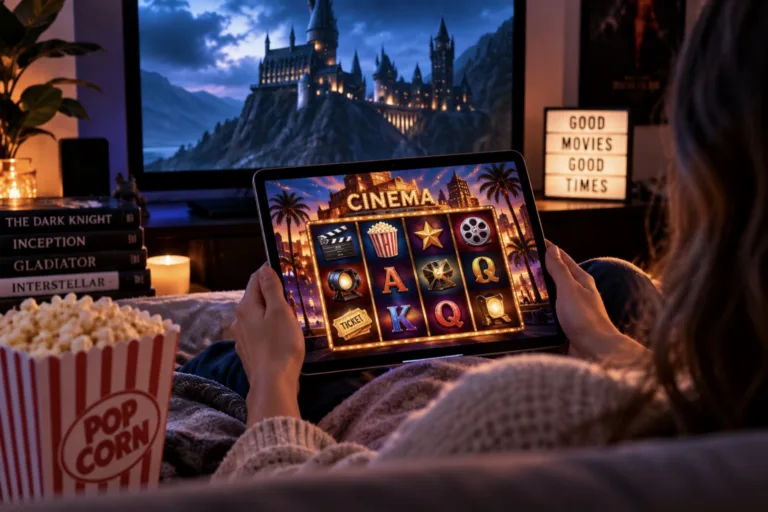
From console adventures to movie slots, Hollywood’s biggest worlds have found plenty of ways to keep us playing after the credits roll
There was a time when reaching the credits meant you were basically done with those characters for good. You might buy the soundtrack, stick a poster on the wall, or argue with your friends about the ending, but the movie itself stayed on the screen.
That boundary has become much harder to spot.
Today, a fictional world can follow you into a console game, appear on your phone, or become an interactive experience on the same TV where you watched the original story. Some franchises even make the journey in the opposite direction. Fallout, The Last of Us, and Minecraft all started as games before finding huge audiences on film or television.
We have reached a point where watching a world and playing inside it can feel like two parts of the same entertainment ecosystem.
Hollywood has become very interested in worlds
The attraction of a great fictional universe is fairly easy to understand. If audiences already know its characters, places, and visual language, there are plenty of directions it can travel next.
Gaming has become a particularly interesting part of that equation.
When the first Minecraft Movie arrived in 2025, director Jared Hess spoke about capturing the spirit and recognizable aesthetics of the original game instead of attempting to copy the experience exactly. Familiar elements such as creepers, zombies, and villagers still made the jump to cinema. No wonder they’re already focusing on a second release.
It works in reverse, too. Movie imagery has been finding its way into games for decades, and slots offer one of the more unusual examples.
What happens when a movie meets the reels?
The first thing a movie-inspired slot needs to communicate is familiarity. There may only be a few seconds before the reels start moving, so the visuals have plenty of work to do. That is where movie slots get interesting. Some are officially licensed adaptations of films or franchises, giving designers access to recognizable characters, locations, and other elements from the source material. Others lean into broader cinematic genres, using the visual language of sci-fi, fantasy, horror, or adventure to create a game that feels like it belongs on a much bigger screen.
Recent movie-themed games have shown how far this idea can go. Some incorporate film footage, photographs, recognizable soundtracks, and cutscenes alongside the reels. The experience can end up looking surprisingly cinematic for something designed around individual rounds.
There are also plenty of moving parts available to designers:
- Wild symbols can replace other symbols and may arrive with their own animations
- Scatter symbols can activate free spins or other features
- Bonus rounds can turn a scene, character, or object into a separate part of the game
- Animated sequences can appear when particular combinations land
- Music and sound effects can change as different features begin
The result is a format that can borrow heavily from cinema while still behaving like a slot game. The best movie slots find recognizable pieces of a film and turn them into something players can interact with.
The best adaptations know what people remember
Turning a film into a game raises an interesting question. Which parts actually make something feel like the movie?
It probably isn’t every detail of the plot.
A few recognizable elements can do an enormous amount of work. Think about the objects you immediately associate with famous films – a particular car, costume, creature, weapon, or location. Add a familiar piece of music and the connection can happen almost instantly.
Games use that kind of shorthand constantly. The original story doesn’t need to be retold from beginning to end. The game needs enough familiar ingredients to bring its atmosphere back.
Games get to hand you the controls
Cinema decides where you look. The camera moves, the editor cuts, and the story continues at the pace chosen by the filmmakers. Games change that relationship because the person watching suddenly has something to do.
A huge console adventure might give someone an entire world to explore. A mobile title can reduce the idea to quick challenges. Slots work on a smaller scale again, using individual rounds alongside visual and audio reactions.
Even the distinction between streaming and gaming has become fuzzier. Netflix allows subscribers to play certain games on compatible TVs and use their phones as controllers. Scan a QR code, connect the phone, and the screen that was showing a movie a moment ago becomes a gaming display.
That would have sounded like a fairly strange Netflix feature when the company was mailing DVDs.
One story can live on a lot of screens
Different formats give creators different amounts of time and different ways to use a fictional world.
| Format | What it can do with a fictional world | Typical experience |
| Movie | Tell a complete cinematic story | Around two hours |
| Streaming series | Expand characters and storylines | Multiple episodes |
| Console or PC game | Let players explore and make decisions | Several hours or longer |
| Mobile game | Turn a theme into quick interactive challenges | Short sessions |
| Movie-inspired slot | Use recognizable visuals, sounds, and themed features | Individual rounds |
| Soundtrack | Bring back the atmosphere through music | A song or full album |
There is no single way for an audience to experience a fictional universe anymore.
Someone might discover a character through a game and eventually watch the movie. Someone else could have loved the film for years before recognizing its imagery somewhere completely different.
Sometimes the game comes first
Perhaps the clearest sign of how much the relationship has changed is the traffic now flowing in both directions.
Gaming properties have become a major source of material for Hollywood. Minecraft made the leap to cinemas, while franchises including The Legend of Zelda and Street Fighter have screen adaptations in development.
There is an interesting creative problem involved in all of this.
A filmmaker adapting a game has to work out what deserves a place in a two-hour story. Game designers working from movies have to find the parts of a fixed story that can become interactive.
Sometimes, that means building a huge, explorable world. Sometimes, it means creating a quick mobile experience – and sometimes, a memorable prop, character, or location becomes a symbol spinning around a set of reels. The main theme through it all is that the game had to have been a popular movie in the first place.
Which movie would you ship as a movie slot?
The credits aren’t really the end anymore
A movie can still be two very enjoyable hours in a dark room with an unnecessarily large bucket of popcorn. It can also be the beginning of a much longer relationship with its fictional world.
Games have become one of the places where that relationship continues.
Some offer enormous landscapes and dozens of hours of exploration. Others turn familiar characters into mobile challenges. Slots compress the idea further, using reels, symbols, bonus sequences, cinematic visuals, and sound to create something designed for shorter sessions.
The format changes, but a great fictional world has an impressive habit of sticking around.
These days, the credits may simply be your cue to pick up the controller.

Thomas Miller is the founder and Editor-in-Chief of Seat42F, covering television, movies and streaming entertainment. He launched Seat42F in 2007 and has spent nearly two decades covering the entertainment industry.