There is no separating Coyote vs. Acme from the strange journey it took to reach theaters. Warner Bros. completed the film, shelved it, and nearly turned it into a tax write-off before Ketchup Entertainment eventually acquired it and gave audiences the chance to decide whether it deserved to survive.
Turns out, it absolutely did.
Coyote vs. Acme is fast, wonderfully ridiculous and far smarter than a movie built around exploding rockets, falling anvils and one perpetually doomed desert predator needs to be. Director Dave Green understands something that has occasionally escaped modern attempts to revive the Looney Tunes: these characters do not need to be reinvented. They just need a world capable of keeping up with them.
The result is a live-action/animation hybrid that embraces the anarchic spirit of the classic cartoons while finding a surprisingly effective story about failure, persistence and what happens when the little guy finally decides to fight back.
Wile E. Coyote Finally Gets a Lawyer
After decades of purchasing Acme products that have exploded, malfunctioned or otherwise contributed to his repeated destruction, Wile E. Coyote finally reaches his breaking point.
Instead of ordering another rocket or oversized slingshot, he calls an attorney.
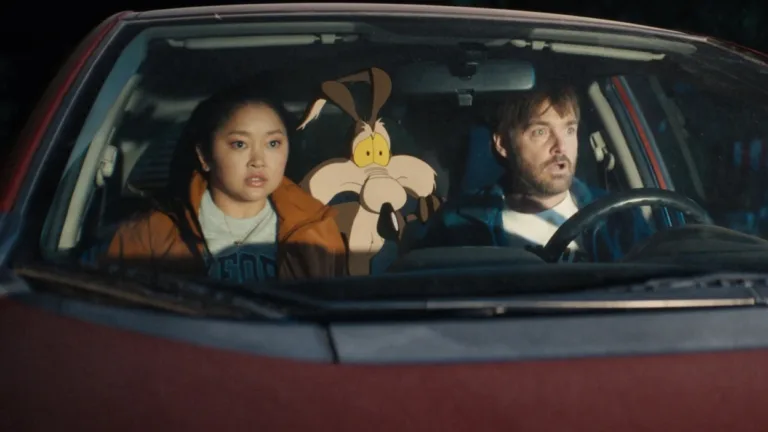
Kevin Avery (Will Forte) is hardly the powerhouse lawyer you would expect to take on one of the world’s biggest corporations. He is a struggling personal-injury attorney accustomed to extracting tiny settlements for cartoon clients who have been flattened, exploded or otherwise injured by Acme products.
Then Wile E. walks through his door with a lifetime’s worth of evidence.
Kevin, his niece and assistant Paige (Lana Condor), and the rest of his small legal team take the case against Acme, putting them opposite Buddy Crane (John Cena), the company’s polished and intimidating attorney.
It is such a simple premise that it is almost surprising nobody made the movie decades ago.
Wile E. Coyote has spent generations buying products that spectacularly fail to do what they promise. Of course he should sue Acme.
More importantly, screenwriter Samy Burch turns that joke into an actual story rather than stretching a five-minute sketch across a feature-length runtime.
Will Forte and John Cena Understand the Assignment
Forte is an ideal human partner for Wile E. Coyote because Kevin is essentially the human version of his client.
Both are beaten down. Both have spent years failing. And neither is particularly convincing as the hero who is about to bring down a corporate giant.
Forte never tries to compete with the cartoons. His awkward, slightly defeated energy gives Wile E. something solid to bounce against, and the relationship between the two gradually provides the movie with more heart than expected.
Cena gets to operate at the opposite extreme.
Buddy Crane looks and behaves like someone who wandered out of a cartoon and somehow became human. Cena plays him completely straight, which only makes him funnier. The enormous personality, immaculate suits and unwavering confidence make Buddy exactly the kind of opponent Kevin and Wile E. should have no realistic chance of defeating.
Lana Condor gives the legal team some needed optimism as Paige, while the movie wisely allows its animated stars to remain recognizably themselves rather than forcing them into some overly modernized version of the Looney Tunes.
The Looney Tunes Are Allowed to Be Looney Again
That may be the movie’s biggest victory.
Green understands the rhythm of these characters.
Wile E. Coyote remains largely silent. Road Runner still has one important thing to say. The physical comedy is violent, elaborate and completely unconcerned with reality. Characters get flattened, blown up and launched through the air because that’s simply how physics works in this universe.
The movie also fills the edges with familiar Looney Tunes faces without turning every appearance into an applause break.
There is nostalgia here, certainly, but Coyote vs. Acme generally uses that history rather than stopping the movie to celebrate it.
The live-action and animation don’t always blend perfectly. Some of the characters can look slightly awkward when the movie asks traditional cartoon designs to exist three-dimensionally beside human performers. It never reaches the visual magic of Who Framed Roger Rabbit, still the obvious benchmark for this type of movie.
But when the movie unleashes its slapstick, those imperfections become much easier to ignore.
The explosions explode. The anvils fall. The rockets inevitably point in the wrong direction.
And Wile E. Coyote keeps getting back up.
A Corporate Satire With an Accidental Second Meaning
This is where Coyote vs. Acme becomes considerably more interesting than another exercise in franchise nostalgia.
Acme isn’t merely a company that sells defective gadgets. It is an enormous corporation powerful enough to make its customers feel insignificant and its opponents feel foolish for challenging it.
Wile E. has spent years faithfully purchasing its products. They repeatedly fail him. Yet somehow he remains the one paying the price.
There is real satire underneath the cartoon violence, touching on corporate power, planned obsolescence, legal intimidation and systems designed to exhaust ordinary people before they can ever win.
Some of that will probably sail directly over younger viewers. A surprisingly large portion of Coyote vs. Acme is an actual legal comedy, and children waiting for the next explosion may not care about the finer points of corporate liability.
Fortunately, another explosion is usually coming.
For adults, however, that extra layer gives the movie some bite.
And then there is the unavoidable irony.
A movie about a small underdog taking on a gigantic corporation was itself completed and shelved by a gigantic corporation before another distributor stepped in to save it.
You could not invent a better marketing campaign.
Wile E. Coyote Is Still the Perfect Underdog
The smartest decision Coyote vs. Acme makes is resisting the temptation to completely transform its title character.
Wile E. does not suddenly become a misunderstood cuddly hero. He is still the obsessive predator who wakes up every morning determined to catch the Road Runner despite decades of evidence suggesting this is a terrible idea.
But that persistence looks different when the story is told from his perspective.
Every catastrophic Acme failure ends the same way.
He gets crushed.
He gets burned.
He falls off a cliff.
And then he tries again.
That repetition has always been the joke. Coyote vs. Acme realizes it can also be the character’s defining virtue.
Wile E. Coyote may be one of pop culture’s greatest failures, but nobody has ever accused him of quitting.
For a movie that nearly disappeared without audiences ever getting to see it, that feels remarkably appropriate.
Final Verdict
Coyote vs. Acme did not need its remarkable Hollywood survival story to justify its existence.
It is funny enough on its own.
Dave Green and Samy Burch have made a Looney Tunes movie that understands why these characters have survived for generations without treating them like museum pieces. The classic slapstick remains intact, the human performers commit completely to the absurdity, and the legal battle gives all that chaos just enough structure and meaning.
The animation isn’t flawless, and the courtroom-heavy middle may test some younger viewers expecting nonstop Road Runner mayhem. Those are relatively small complaints about a movie this inventive and consistently entertaining.
The greatest surprise isn’t that Coyote vs. Acme survived.
It’s that anyone watched the finished movie and thought audiences shouldn’t.
Seat42F Rating: 8.8/10
Coyote vs. Acme opens in theaters Friday, August 28, 2026.
Read more about Coyote vs. Acme’s remarkable road to theaters at AP

Thomas Miller is the founder and Editor-in-Chief of Seat42F, covering television, movies and streaming entertainment. He launched Seat42F in 2007 and has spent nearly two decades covering the entertainment industry.