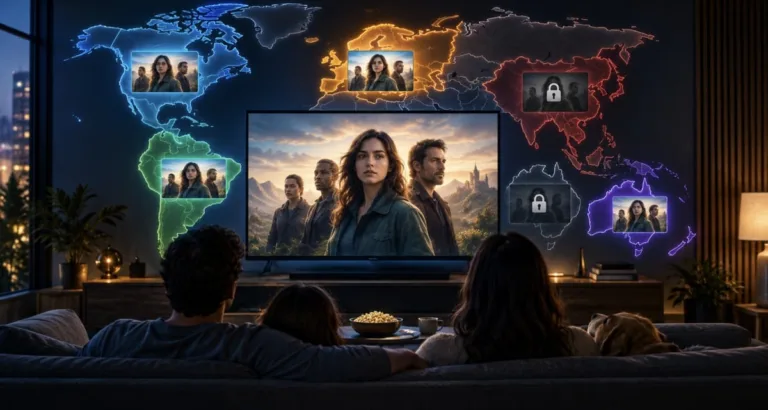
Every week the Netflix Top 10 lists show the same pattern. A series sits at number one in the United States and barely registers in Canada, or it climbs the chart in Brazil while American viewers can’t find it anywhere on their version of the service. For viewers it can look random, but there is a system behind it. Where a show streams depends on who owns the rights in each country, and those rights are sold territory by territory, often years before anyone presses play.
Originals travel, licensed shows do not
The simplest split is between originals and licensed titles. A series that a streamer produced or fully owns usually launches worldwide on the same day. A licensed series works differently. The studio that made it sells streaming rights country by country, and the buyer in each market can be a different company with its own app.
That is why HBO series have for years streamed in Canada on Crave rather than on HBO’s own service, and why a show made for one American network can turn up on Netflix in Europe while viewers in the US need a completely different subscription. When Friends left Netflix in the United States at the start of 2020 to join HBO Max, it stayed on Netflix in many other countries, because the deals outside the US had not changed.
Windows as well as deals
Movies add another layer. A film moves through windows: theaters first, then digital rental and purchase, then a first subscription home, and later other services. In the United States, Universal films have gone to Peacock first and Netflix afterwards under a deal announced in 2021, while Sony’s films have gone to Netflix first. Other countries have window deals of their own, with different companies and different dates, so a film can stream in one market months before it arrives in another.
Expiring licenses explain the other half of the puzzle, the sudden disappearances. When a deal ends, the title leaves that country’s library on a set date, and services often give only a few weeks of warning. The same show may have years left on its contract somewhere else.
How trackers keep up with thousands of catalogs
Knowing where something streams has become a small industry. Guide apps and entertainment writers who answer the question “where can I watch this” have to check the catalog of every major service in every country they cover, and those catalogs change daily as titles arrive and expire.
Streaming sites show their public title pages according to the visitor’s location, so a check made from New York says nothing about Toronto or London. Services that track availability at scale often run these checks through datacenter proxy servers in each market, fast connections hosted in data centers inside the country being checked, which let an automated check read a public page the way a local visitor would see it.
Watching is a different matter. Accounts are tied to the country where the subscriber lives, and the services work hard to stop people from streaming another country’s library, so the useful part of all this tracking is simply knowing where to look.
How to find where a show is streaming
- Search inside the apps you already pay for first, since their own search reflects your country’s library.
- Use a streaming guide app set to your country, and note the date it gives for when a title leaves.
- Look at the network or studio behind the show. A series made for one company often ends up on that company’s own service once older deals run out.
- Check free, ad-supported services too. Plenty of older series live on free streaming channels rather than on the big subscriptions.
- Keep an eye on physical media. Some titles never stream legally in a given country, and a Blu-ray or a digital purchase is the only reliable way to keep them.
Why this will not get simpler soon
If anything, the map is getting more complicated. Studios keep pulling some titles back to their own services while licensing others out again for the money, and a show can move twice in a single year. For fans, the practical habit is to check availability before starting a long series, not halfway through season three.
It also helps to read the fine print in streaming news. When a service announces that a show is “coming soon,” the date almost always applies to one country, and the rest of the world may be waiting on a deal that has not been signed yet.
FAQ
Why did a show disappear from my streaming service?
Most often because the license for your country ran out. The show may still stream elsewhere, or it may move to another service in your country.
Are streaming originals available everywhere?
Most launch worldwide, but not all. Star Trek: Discovery, for example, carried the Netflix label in much of the world while American viewers watched it on CBS All Access.
Why does one country have more seasons of a show than another?
Seasons can be licensed separately, so one market may have the latest season while another is still waiting for its deal to start.

Thomas Miller is the founder and Editor-in-Chief of Seat42F, covering television, movies and streaming entertainment. He launched Seat42F in 2007 and has spent nearly two decades covering the entertainment industry.