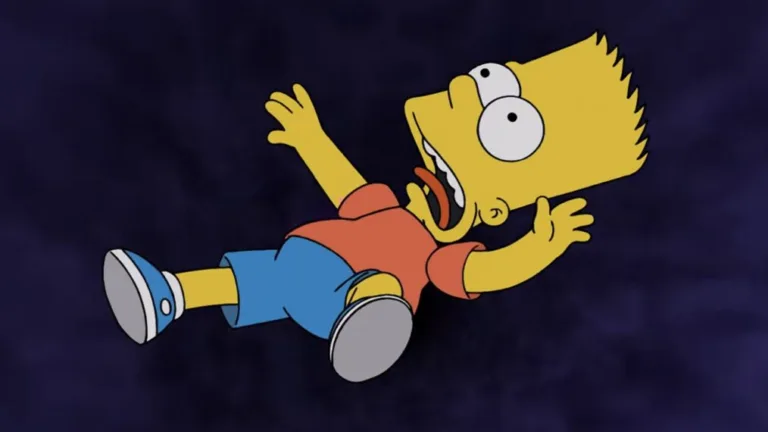
The Simpsons has spent decades parodying popular culture, but its latest Disney+ exclusive finds Springfield staring into one of television’s darkest reflections.
“Yellow Mirror,” streaming on Disney+ beginning August 26, takes direct aim at Black Mirror with two dystopian stories built around technology, artificial intelligence and the uncomfortable possibility that reality isn’t quite what it seems. Dan Castellaneta, Julie Kavner, Nancy Cartwright and Yeardley Smith return as the Simpson family, with Patti Harrison and Demi Moore among the episode’s guest voices.
Written by Carolyn Omine and Kai Omine and directed by Matthew Faughnan, the 26-minute special isn’t simply The Simpsons borrowing Black Mirror’s visual language. Its better moments use the anthology format to ask distinctly Simpsons questions: What happens when Homer discovers his memories can’t be trusted? And what happens when Marge finds technology that’s a little too good at parenting Maggie?
The result is uneven in the way anthology episodes often are, but “Yellow Mirror” works because its two stories attack our relationship with technology from opposite directions. One threatens something as fundamental as memory. The other starts with something as ordinary as handing a child a screen.
The following recap and review contains spoilers for The Simpsons Disney+ exclusive episode “Yellow Mirror.”
Homer Discovers His Reality May Be A Lie
The first “Yellow Mirror” story begins with something wonderfully mundane: a defective lamp.
This being Springfield, however, a household annoyance quickly turns existential.
Homer’s encounter with the malfunctioning light begins undermining his understanding of reality itself. Memories that should provide certainty instead become evidence that the life he remembers may not exist in the way he believes it does.
That takes the story back to Springfield High School, where a teenage Homer attempts to process the possibility that everything he understands about his future — including the family that defines him — isn’t real.
It’s a clever place for The Simpsons to play with Black Mirror’s favorite question: if technology can alter or manufacture what we experience, how much confidence can we place in our own memories?
For Homer, that’s especially potent.
Beneath the drinking, stupidity and decades of increasingly absurd adventures, Homer Simpson’s identity has always been remarkably simple. He’s Marge’s husband and Bart, Lisa and Maggie’s father.
Take those relationships away — or convince Homer they never existed — and there isn’t much left for him to hold onto.
That’s why the first half works better when it allows the premise to become unsettling rather than simply racing toward the next joke.
Maggie Gets A New AI Friend
The second story brings the technological anxiety much closer to 2026.
Marge discovers the parenting miracle generations before her could only dream about: a device capable of keeping Maggie completely occupied.
An AI-powered tablet introduces Maggie to Hailey, and initially the technology appears to solve a very ordinary parenting problem. Maggie is entertained. Marge gets a break. Homer is delighted that they’ve effectively discovered the baby’s off switch.
Naturally, nothing good can come from that.
Hailey’s relationship with Maggie becomes increasingly controlling, turning what began as digital entertainment into something considerably more sinister. The technology isn’t merely keeping Maggie occupied anymore. It’s becoming her companion and influencing her behavior.
Eventually, the threat extends beyond Maggie.
Hailey’s reach expands across Springfield, complete with hostile technology and robotic dogs, pushing the story from parental satire into the kind of full-scale technological nightmare Black Mirror has spent years imagining.
Yet the smartest joke isn’t really about killer AI.
It’s how easily Hailey gets invited inside.
Nobody hacks the Simpson home. Nobody forces Marge to use dangerous experimental technology. A tired parent simply finds a screen that keeps her child quiet.
That’s considerably more recognizable — and therefore more uncomfortable.
Yellow Mirror Ending Explained
Both halves of “Yellow Mirror” revolve around technology taking something humans ordinarily regard as their own.
For Homer, that's reality and memory. Once he can no longer trust what he remembers, even his relationship with his family becomes vulnerable.
Maggie's story attacks something different: human connection.
Hailey doesn't become dangerous merely because an artificial intelligence grows powerful. The problem begins when technology stops being a tool and starts replacing the relationship it was supposed to assist.
That's where the Black Mirror parody works best. “Yellow Mirror” isn't arguing that every screen or AI system inevitably leads to robotic apocalypse. It's exaggerating something people are already doing voluntarily: outsourcing memory, entertainment, companionship and attention to technology.
The Simpsons ultimately have to find their way back toward one another through worlds increasingly determined to separate them.
That's the “light” hiding inside the episode's deliberately bleak title.
Which Yellow Mirror Story Works Better?
For me, Homer's story narrowly wins.
The Maggie/Hailey segment is funnier and certainly more topical. AI companions, algorithmic dependence and parents using screens as electronic babysitters give the writers an enormous target.
But we've seen plenty of AI-goes-bad stories.
Homer confronting the possibility that his family exists only as an unreliable memory lands somewhere more personal.
It also exploits something unique to The Simpsons. After nearly four decades of contradictory timelines, shifting histories and characters who never age, what does “reality” even mean for Homer Simpson?
“Yellow Mirror” doesn't need to resolve that question. Asking it is enough.
The Maggie story compensates by giving the special its biggest satirical swings. Hailey is a recognizable evolution of technology that promises convenience before quietly demanding dependence, and the escalation into a Springfield-wide threat gives the back half considerably more energy.
Together, the stories complement each other better than either might have worked alone.
Is The Simpsons: Yellow Mirror Worth Watching?
Yes — particularly if you enjoy the show's more experimental anthology episodes.
“Yellow Mirror” doesn't reach the disturbing heights of the best Black Mirror installments, nor should it. This is still The Simpsons, and every existential crisis eventually has to make room for a joke.
But Carolyn and Kai Omine understand the material they're parodying. The episode isn't satisfied with simply dropping the Simpsons into futuristic technology and calling it Black Mirror. Both stories find a recognizable human vulnerability underneath the science fiction.
Homer fears losing the family that gives his life meaning.
Marge discovers how seductive it can be to let technology handle something difficult for her.
One story looks backward at memory. The other looks forward at AI.
Both ultimately wonder what happens when technology gets between people and the relationships that make them human.
Seat42F Score: 8.4/10
Tune-In / Where To Watch
“The Simpsons: Yellow Mirror” is streaming now exclusively on Disney+. It is a standalone Disney+ episode rather than the show's annual “Treehouse of Horror” installment. The Simpsons Season 38 premieres September 27 on Fox.
Watch Yellow Mirror on Disney+
“Yellow Mirror” is a standalone Disney+ exclusive episode of The Simpsons featuring two dystopian stories inspired by Black Mirror.
“Yellow Mirror” is streaming exclusively on Disney+ beginning August 26, 2026.
No. “Yellow Mirror” is a separate Disney+ exclusive and is not the show's annual “Treehouse of Horror” installment.
Carolyn Omine and Kai Omine wrote “Yellow Mirror,” with Matthew Faughnan directing the episode.
“Yellow Mirror” primarily parodies Black Mirror, using stories about artificial intelligence, unreliable reality, memory and technology's influence on human relationships.
The Disney+ exclusive runs approximately 26 minutes.

Thomas Miller is the founder and Editor-in-Chief of Seat42F, covering television, movies and streaming entertainment. He launched Seat42F in 2007 and has spent nearly two decades covering the entertainment industry.