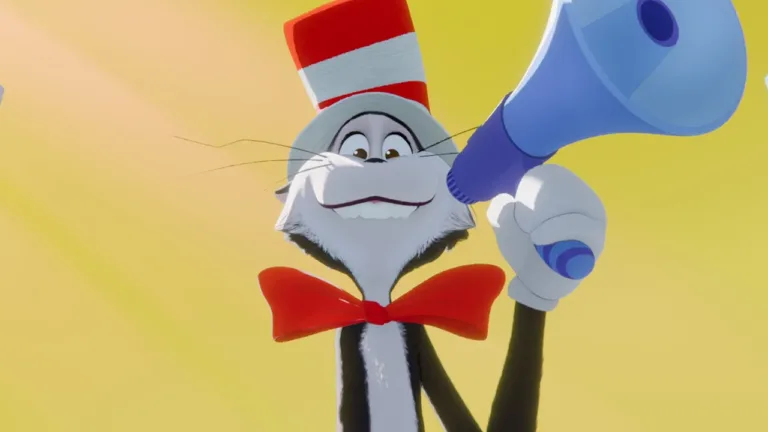
The Cat in the Hat has a good joke about its title character: someone has made the mistake of giving him a job. The Cat is now a professional cheerer-upper with an employer, a performance problem and a magical hat he could lose. That idea is funny as long as the rules exist for him to break. The trouble starts when the movie gets so busy explaining those rules and sending him from one world to the next that he has less room to surprise anybody.
Bill Hader voices the Cat, with Matt Berry as Waffles the goldfish, the one member of the party who sounds as though he’d rather be anywhere else. Xochitl Gomez and Tiago Martinez play Gabby and Sebastian, siblings adjusting to a move that their mother, Carmen (America Ferrera), made for work. Directors and co-writers Erica Rivinoja and Alessandro Carloni have two promising ideas here: an absurd workplace comedy for the Cat and a story about a family whose members miss different things about home. Either could have carried more of the movie.
Bill Hader Makes the Cat an Overconfident Coworker
In Dr. Seuss’s book, part of the fun is that the Cat needs no explanation. He arrives, acts like he belongs and gets away with it long enough to make a spectacular mess. The film gives him an office at the Institute for the Institution of Imagination and Inspiration, LLC, where Giancarlo Esposito voices his boss and Quinta Brunson plays his ally in HR. There’s a good adult joke in the distance between the organization’s purpose and its paperwork. If you’re paid to make children happy, what happens when you’re very good at that and a disaster by every other measure?
Hader’s Cat is so pleased with his own ideas that the smaller line readings can be funnier than the big declarations. A muttered aside lets him sound like he’s privately congratulating himself for getting away with something. Berry has the opposite assignment. Waffles is a goldfish in a bowl, but he sounds like the only person qualified to write up the incident. Their difference in pace gives the comedy some shape. The Cat keeps asking everyone to get excited; Waffles can make a joke out of simply declining.
There’s a limit to how much the workplace premise can explain before it takes away some of the fun. Giving the Cat a reason to show up makes sense in a feature built around his point of view. Giving him a job to save also turns a character who’s supposed to make everyone else uncomfortable into someone the audience is asked to reassure. Hader can sell both versions. The more interesting one is the Cat who hasn’t quite figured out why anyone would object to his methods.
The Moving Boxes Are the Right Kind of Expansion
The best new idea is sitting in the family’s apartment. Their belongings are still packed, and the film turns the moving boxes into entrances to different worlds. Carloni has described how the production gave those spaces distinct visual styles in Skydance’s cast and filmmakers feature. The shift from the rounded look of the everyday scenes to more graphic, illustrative spaces gives the animation room to surprise. It also makes sense from a child’s point of view: a cardboard box is already half an invitation to imagine something else.
Better still, the boxes give the filmmakers a way to talk about the move through the things the family packed. Gabby misses her old friends and her marching band. Sebastian misses playing with his sister, even though she’s still in the next room. Carmen is trying to keep both kids moving forward while settling into work herself. The film is on firmer ground when it allows those frustrations to coexist. A child doesn’t need to be told why it hurts when an older sibling stops wanting to play the games they invented together.
That’s why the race to recover a time-bending device feels like a less interesting use of the worlds the animators have built. A monster supplies a clear threat and a reason to keep everyone moving, but each new demand takes a little time away from what the boxes can tell us about the family. The movie can make the universe feel endangered. It’s harder, and more rewarding, to make a kid’s old band uniform feel like something worth missing.
Is The Cat in the Hat Worth Seeing?
For families looking for a lively outing, there’s a lot to respond to: Hader’s voice, Berry’s dry interruptions and an animation team that gets to change the look of the movie midstream. There’s also plenty of noise, broad slapstick and a creature that may be too intense for children expecting the gentler experience of reading the book aloud. The movie has enough invention to justify going beyond the original setup. It has more trouble knowing when it’s gone far enough.
The family’s move gives this Cat a reason to visit Gabby and Sebastian, and the best jokes make you glad he did. The movie would have been funnier if it trusted those two things to hold an audience. Waffles doesn’t need the universe to be in danger to make a scene worth watching. That’s a lesson the Cat could stand to learn from his fish.
The Cat Is Funnier When the Stakes Are Smaller
Bill Hader and Matt Berry make a funny pair, but the film keeps interrupting them to save the universe.
The moving boxes give the animators new styles to play with and tie the fantasy to the family’s move.
Matt Berry’s Waffles gets laughs by being the least impressed creature in the room.
Hader’s sly asides and the different things Gabby and Sebastian miss about their old life.
The time device and monster chase crowd out the family story and the Cat’s smaller comic moments.
Where to Watch The Cat in the Hat
The Cat in the Hat opened in North American theaters and IMAX on Friday, November 6, 2026, from Warner Bros. Pictures. Visit the official film site for trailers and film information.
The Cat in the Hat FAQ
Who voices the Cat and Waffles?
Bill Hader voices the Cat, and Matt Berry voices Waffles the goldfish.
Is the 2026 movie a remake of the Mike Myers film?
No. It’s a separate animated adaptation of the Dr. Seuss book, with a new story about siblings Gabby and Sebastian.
What is The Cat in the Hat rated?
It’s rated PG for action, some peril, mild language and rude humor. The monster and chase scenes may be scary for younger children.

Thomas Miller is the founder and Editor-in-Chief of Seat42F, covering television, movies and streaming entertainment. He launched Seat42F in 2007 and has spent nearly two decades covering the entertainment industry.