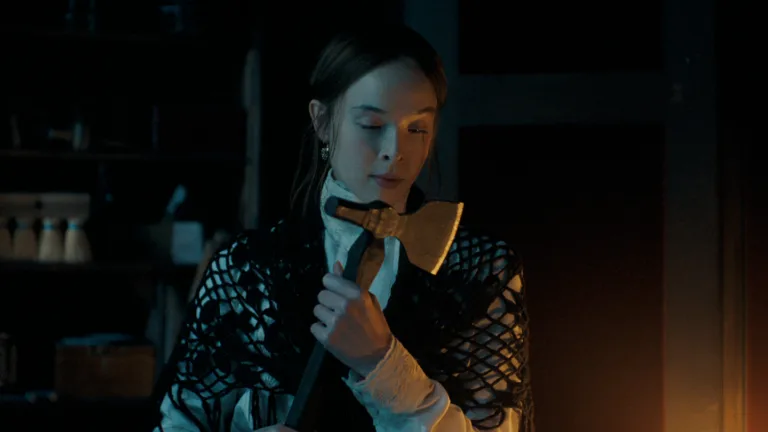
Monster: The Lizzie Borden Story arrives with the kind of built-in fascination few true-crime dramas can buy. The 1892 Fall River murders have been turned into a nursery rhyme, a courtroom legend and an enduring question mark. Netflix’s eight-episode addition to the Monster anthology knows all of that. It just does not always know how much of that history it wants to honor before it starts inventing around it.
That makes the series a better fit for viewers looking for a feverish, stylized gothic drama than a careful re-creation of the Borden case. It is handsome, strange and often compelling—especially whenever Ella Beatty and Rebecca Hall are allowed to make the Borden home feel like a pressure cooker—but its appetite for provocation sometimes outruns its more interesting ideas about repression, family and the stories people tell about women.
Ella Beatty Gives Lizzie Borden a Real Center
Beatty has the difficult job of playing someone who has been flattened by more than a century of cultural shorthand. Rather than chasing the familiar rhyme or treating Lizzie as a blankly unknowable enigma, she gives the character a sharp, watchful interior life. There is a sense that Lizzie is always measuring the room around her—who has power, who is watching and what version of herself she is expected to perform.
It is an impressive television lead turn, and one the series needs. The writing often pulls Lizzie toward metaphor, fantasy and outright spectacle, but Beatty keeps finding the human stakes beneath the showier choices. She makes the character’s restlessness feel less like a puzzle to solve than a response to an impossibly suffocating life.
Hall is just as valuable as Abby Borden. She gives the household conflict a hard, unsentimental edge and does not let the role collapse into a simple villain. Charlie Hunnam, Billie Lourd and Vicky Krieps round out a cast that understands the show is playing in a heightened register. Krieps in particular brings warmth and intelligence to Bridget Sullivan without reducing her to a mere plot device.
Monster Turns the Borden House Into a Gothic Pressure Cooker
At its best, Monster: The Lizzie Borden Story feels less like a conventional procedural than a bitter domestic nightmare. The cramped rooms, formal clothes and rigid social codes create a world where every conversation feels staged for judgment. The production leans into that claustrophobia with confidence, finding unnerving beauty in the period details without losing the grime and emotional chill underneath them.
That approach also gives the season a more distinctive identity than a straightforward “did she or didn’t she?” retelling would have had. The Lizzie Borden case has endured precisely because the facts leave room for projection, and the series uses that uncertainty to explore female rage, class and the public’s hunger to make a woman either saint or monster.
Where the Series Loses Its Grip
The problem is that the show can become so eager to modernize, sexualize and mythologize its subject that it starts to crowd out the unnerving simplicity of the case itself. This is not a docudrama, and it does not pretend to be one. Still, some of its most audacious inventions feel less like a fresh angle than an attempt to keep escalating after the performances have already earned the audience’s attention.
That tonal impatience makes the eight-episode format feel longer than it needs to. The strongest material is quiet: a glance across a dinner table, an argument that reveals a family hierarchy, a woman realizing that the rules will never make room for her. When the season trusts those moments, it has real bite. When it reaches for its broadest shocks, it can feel like the show is mistaking noise for daring.
Is Monster: The Lizzie Borden Story Worth Watching?
Yes, with the right expectations. This is not the definitive Lizzie Borden story, nor is it especially interested in being one. It is a deliberately subjective, frequently lurid interpretation of a case that has been mythologized for more than 130 years. Viewers who want a historically grounded account may find the liberties frustrating. Viewers willing to meet it as a glossy, performance-driven gothic melodrama will find enough to hold onto.
Beatty gives the season a confident lead performance, Hall provides its sharpest counterweight, and the design gives the whole thing a haunted visual texture. Even when it is overreaching, Monster: The Lizzie Borden Story is rarely dull. The better version of this season is hiding in plain sight: a leaner, more patient drama about a family, a house and a woman the world decided it understood. What Netflix delivers is messier than that—but still hard to look away from.
The Monster Team and Cast Behind The Lizzie Borden Story
Monster: The Lizzie Borden Story is the latest installment in Ryan Murphy and Ian Brennan’s Netflix anthology, with Brennan credited as creator. Max Winkler directs most of the eight-episode season, while Sarah Adina Smith also directs. As with the previous Monster installments, the series uses a real-life crime as a starting point for a deliberately stylized, heavily dramatized interpretation rather than a strict historical re-creation.
Ella Beatty leads the cast as Lizzie Borden, alongside Rebecca Hall as Abby Borden, Charlie Hunnam as Andrew Borden, Billie Lourd as Lizzie’s sister Emma and Vicky Krieps as Bridget Sullivan. The ensemble also includes Jessica Barden as actress Nance O’Neil, Joey Pollari as John Morse and Sarah Paulson as Aileen Wuornos.
Final Verdict
Ella Beatty and Rebecca Hall elevate a visually striking, frequently absorbing season whose wildest choices too often blur the line between bold interpretation and empty escalation.
A Gothic Drama With a Wild Streak
Ella Beatty and Rebecca Hall give Netflix’s feverish Lizzie Borden retelling more weight than its loudest choices deserve.
The tense, intimate scenes that turn the Borden house into a trap without needing to raise their voice.
Ella Beatty, with Rebecca Hall providing the season’s sharpest counterweight.
The gothic design, the central performances and its strongest ideas about repression and public mythmaking.
Its appetite for sensational detours sometimes overwhelms the richer family drama already on the page.
Where to Watch Monster: The Lizzie Borden Story
All eight episodes of Monster: The Lizzie Borden Story are now streaming on Netflix.
Follow Seat42F for Netflix reviews, release dates, trailers, photos and streaming news.

Thomas Miller is the founder and Editor-in-Chief of Seat42F, covering television, movies and streaming entertainment. He launched Seat42F in 2007 and has spent nearly two decades covering the entertainment industry.