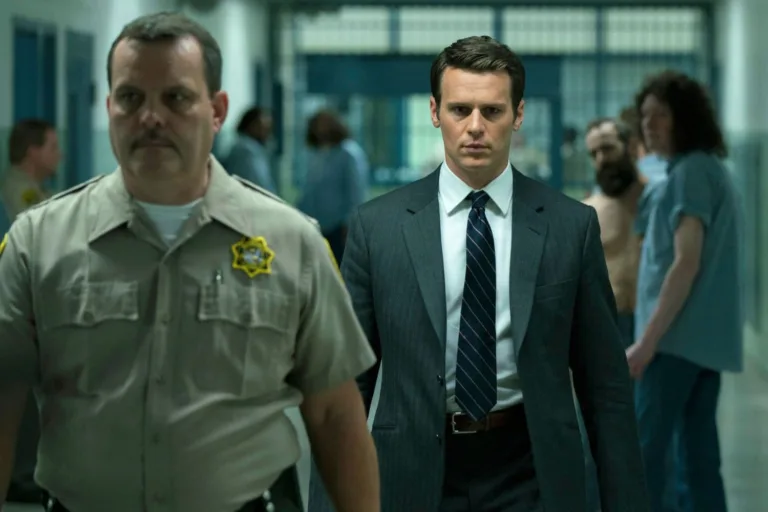
Mindhunter Season 1 Episode 1 doesn’t begin with a serial killer. Instead, David Fincher’s Netflix drama introduces FBI agent Holden Ford (Jonathan Groff) at a hostage standoff that goes horribly wrong — or, depending on whom you ask, exactly as well as could be expected.
That distinction becomes the foundation for everything that follows.
Set in 1977, the series premiere introduces Holden as a young FBI hostage negotiator increasingly frustrated by law enforcement’s inability to explain a changing kind of violent criminal. His superiors are satisfied with procedures that work. Holden wants to understand why they work — and, more importantly, why sometimes they don’t.
That curiosity eventually puts him alongside veteran Behavioral Science Unit agent Bill Tench (Holt McCallany), beginning the partnership that will push the FBI toward studying killers instead of simply catching them.
Directed by David Fincher and written by series creator Joe Penhall, Mindhunter Episode 1 is deliberately patient. There isn’t a conventional murder investigation to solve or a monster to catch. The mystery is something much larger: What makes someone kill when the usual explanations no longer seem to apply?
A Hostage Negotiation Changes Holden Ford
The premiere opens in Braddock, Pennsylvania, where Cody Miller has taken hostages and barricaded himself inside a building.
Holden arrives as the FBI’s negotiator and immediately finds himself caught between two very different approaches.
The police surrounding Miller are prepared for confrontation. Holden wants communication.
Miller is unstable, paranoid and increasingly unpredictable. Holden tries to keep him talking, hoping that establishing some kind of human connection will defuse the situation.
It doesn’t.
Miller suddenly kills himself with a shotgun in front of Holden.
The scene is shocking, but what happens afterward is arguably more important.
Holden believes the negotiation failed because somebody died. His superiors see it differently: the hostages survived, no law-enforcement officers were killed, and the only casualty was the perpetrator.
From the FBI’s perspective, that’s a successful outcome.
Holden can’t accept it.
He’s left with blood on his clothes and a question nobody around him seems particularly interested in answering: Could understanding Miller have changed what happened?
It’s our first glimpse of the obsession that will define Holden. He’s less interested in labeling people insane than figuring out what that label actually means.
The FBI Has a New Kind of Criminal Problem
Back at Quantico, Holden teaches hostage negotiation to FBI trainees, but he’s increasingly dissatisfied with the ideas he’s expected to pass along.
The old rules of criminal behavior make sense when the motive is obvious. Someone robs a bank for money. Someone murders a spouse out of jealousy. Find the motive and you can begin understanding the crime.
But America has changed.
Charles Manson and the Manson Family murders have already happened. David Berkowitz, the Son of Sam, has terrorized New York. Violent crimes increasingly appear to lack the tidy motives investigators have been trained to identify.
Holden recognizes the problem before he has the vocabulary to describe it.
What if “crazy” isn’t an explanation?
What if it’s the beginning of the question?
His desire to understand the psychology behind these crimes leads him outside the FBI’s traditional way of thinking and into academia.
Debbie Mitford Opens Another Door
Holden begins attending classes in Charlottesville, where his buttoned-up FBI worldview collides with ideas coming from psychology, sociology and a generation questioning established institutions.
It’s also where he meets graduate student Debbie Mitford (Hannah Gross).
Their first interactions establish just how sheltered Holden really is. Debbie challenges him intellectually, socially and culturally. Even something as simple as smoking marijuana makes him look like someone visiting an alien planet.
Their relationship is more important to the premiere than it initially appears.
Debbie isn’t simply being introduced as Holden’s girlfriend. She represents another source of information he’s willing to consider.
That’s Holden’s defining characteristic in Episode 1.
He doesn’t know the answers.
But unlike many of the people around him, he’s willing to admit that.
He watches Dog Day Afternoon. He listens to academics. He questions FBI doctrine. He considers environmental and social influences on criminal behavior.
Some of his conclusions are clumsy, and occasionally his enthusiasm gets far ahead of his experience, but he’s willing to entertain ideas that don’t fit comfortably inside the Bureau.
That makes him dangerous to an institution built around certainty.
Holden Ford Meets Bill Tench
Holden’s questions eventually bring him to Bill Tench, a veteran FBI agent working in Behavioral Science.
Bill isn’t another version of Holden.
That’s exactly why their partnership works.
Where Holden is eager, academic and sometimes painfully naive, Bill understands cops, bureaucracy and the practical realities of law enforcement. He’s interested in behavioral psychology, but he knows that an idea isn’t useful if nobody will listen to it.
Tench travels around the country teaching local police departments, and Holden begins accompanying him.
For Holden, it’s an opportunity to take theories out of the classroom.
For Bill, Holden offers something equally useful: a younger agent willing to challenge assumptions Bill already suspects aren’t good enough.
Their first road trip makes the differences between them obvious.
Holden talks about changing social conditions and suggests that even someone like Charles Manson needs to be understood in the context of his environment. The idea doesn’t exactly thrill a room filled with police officers.
Bill understands immediately what Holden hasn’t learned yet.
Being right isn’t enough.
You have to know how to communicate with the people you’re trying to convince.
A Murder in Iowa Turns Theory Into Something Real
The premiere’s final act brings Holden and Bill’s philosophical discussions into contact with an actual unsolved crime.
While teaching police in Fairfield, Iowa, they’re approached by Detective Frank McGraw (Thomas Francis Murphy), who wants their thoughts about a disturbing murder.
A woman and her child have been killed, and the crime includes a particularly grotesque sexual element involving a broomstick.
The local investigators can describe what happened.
What they can’t explain is why.
That’s precisely the problem Holden has been trying to solve.
The crime doesn’t comfortably fit the traditional categories investigators rely upon. The brutality seems to mean something, but nobody knows what.
Holden begins throwing out theories, trying to understand what the killer’s behavior might reveal about him.
Bill is more cautious.
They don’t solve the murder.
That’s important.
A more conventional crime procedural would use this moment to demonstrate that Holden’s revolutionary new approach works. Mindhunter does something more interesting: it shows how little anyone actually knows.
Holden and Bill don’t yet possess a system for interpreting behavior.
They’re beginning to realize they need one.
What Does The Ending Of Mindhunter Season 1 Episode 1 Mean?
The ending of Mindhunter Episode 1 isn’t about solving the Iowa murder. It’s about Holden and Bill recognizing that crimes like it expose a hole in conventional law enforcement.
Police know what happened.
They can collect evidence and reconstruct a crime scene.
But understanding why someone would commit a seemingly motiveless act of extreme violence is something else entirely.
Holden believes the answer may come from studying the people capable of committing these crimes.
Instead of looking away from killers because they’re monsters, someone needs to sit across from them and listen.
That idea is the real breakthrough at the end of the premiere.
Neither Holden nor Bill knows exactly where it will lead yet, and the FBI certainly hasn’t embraced it. But the intellectual foundation of what will become their work has been established.
The episode begins with Holden failing to understand a disturbed man until it’s too late.
It ends with him deciding that understanding people like that has to become the work.
Mindhunter Episode 1 Review
Watching Mindhunter Season 1 Episode 1 years after its original release actually makes its restraint more impressive.
Fincher knows exactly what kind of series viewers believe they’re watching. The opening credits tease horrifying imagery. The subject matter promises serial killers. Anyone coming to Mindhunter because they’ve heard about Edmund Kemper and the show’s infamous interview scenes might expect the premiere to get there immediately.
It doesn’t.
Instead, Fincher and Penhall spend most of the hour explaining why those conversations need to happen in the first place.
That makes Episode 1 a genuine origin story — not for Holden Ford, but for an idea.
Jonathan Groff is particularly effective because Holden needs to be both appealing and slightly irritating. His curiosity is admirable, but there’s already something uncomfortable about the intensity behind it. He can become so interested in understanding behavior that he doesn’t always notice how his own behavior affects the people around him.
Holt McCallany provides the perfect counterweight. Bill has enough experience to recognize the value in Holden’s questions while also understanding why Holden’s approach is going to get them thrown out of rooms.
Their partnership gives Mindhunter its engine.
The premiere also looks unmistakably like David Fincher. Rain, darkness, controlled compositions and an almost clinical visual precision make the series feel closer to Zodiac than a traditional television crime procedural.
That’s fitting because Mindhunter isn’t particularly interested in the comforting rhythm of crime, clues and arrest.
It’s interested in obsession.
Most importantly, Episode 1 trusts viewers to wait.
There is no Ed Kemper interview yet. No dramatic breakthrough suddenly proves Holden right. No case is neatly solved before the credits roll.
There’s just a question.
Why?
By the end of Mindhunter Season 1 Episode 1, Holden Ford has decided that question is worth building his career around.
Where to Watch Mindhunter
Mindhunter Seasons 1 and 2 are available to stream on Netflix.

Thomas Miller is the founder and Editor-in-Chief of Seat42F, covering television, movies and streaming entertainment. He launched Seat42F in 2007 and has spent nearly two decades covering the entertainment industry.