Dexter: Resurrection Season 2 Episode 1 finds a new source of danger in an old habit: Dexter Morgan’s ability to convince himself that his desires serve a greater purpose. “Risky Business” moves the story forward three years, gives Harrison a future to build and leaves his father wondering why his own life feels so small. The result is a darkly funny premiere that makes getting older a practical problem as well as an emotional one.
Michael C. Hall brings that frustration to Dexter, while Jack Alcott gives Harrison a newly independent direction. James Remar’s Harry remains the voice Dexter argues with inside his own head. The arrival of Brian Cox and Dan Stevens introduces contrasting threats, but the premiere’s most immediate test comes from Eric Stonestreet’s Al Walker, better known as Rapunzel.
Dexter’s Dream Cannot Make Batista’s Death Right
The premiere opens with a fantasy that lets Dexter imagine an impossible reconciliation. Angel Batista joins him in a crime-fighting partnership, giving his old colleague the approval he could never offer in life. David Zayas’ return is deliberately comforting for Dexter and uncomfortable for anyone who remembers what that comfort costs.
Batista has not returned from the dead. He exists here in Dexter’s imagination, where a man who pursued the truth can be rewritten as someone who endorses Dexter’s violence. The dream gives Dexter precisely what reality withheld: permission from a person whose judgment mattered.
Harry’s subsequent reassurance does something similar. He suggests that Batista’s inability to accept Dexter explains the tragedy, allowing Dexter to move the blame away from himself. Because Harry is a projection of Dexter’s mind, this is no independent verdict. The opening establishes how efficiently Dexter can turn grief into a story that protects him.
Three Years Later, Dexter Wants More Than Survival
Dexter has remained in New York, working as a ride-share driver and continuing to pursue killers. The Midnight Wrangler and the Yonkers Slayer are among the targets he has eliminated since the events surrounding Leon Prater. His hunting has become routine enough that losing a familiar location to a Whole Foods development feels like another ordinary inconvenience.
That combination of the mundane and the horrifying gives the premiere its comic rhythm. Dexter can deal with a serial killer, yet a dismissive passenger leaves him stewing over his status. He has survived extraordinary threats only to find himself living anonymously in a basement apartment, with little visible evidence of accomplishment.
Even Blessing’s concern about his nearly unchanged living space exposes the gap between Dexter’s private activity and his public existence. From the outside, his life looks stalled. Inside his own narration, he has been doing work he considers valuable. The problem is that he increasingly wants someone else to recognize it.
That desire is more dangerous than a passing complaint about aging. Anonymity has helped keep Dexter alive. Recognition would expose the very thing he needs to conceal. His frustration therefore challenges the rule that makes everything else possible: avoiding capture.
Harrison Graduates Into a Different Life
Harrison’s circumstances have moved in the opposite direction. He graduates from the police academy with a career ahead of him, becoming an NYPD rookie after arriving in New York with very little stability. His relationship with Dexter has also become more settled, though accepting his father’s nature does not mean accepting every consequence of it.
The premiere places their competing forms of purpose beside each other. Harrison can pursue justice through an institution, receive recognition for his achievements and imagine a future beyond his father. Dexter’s accomplishments remain secret, and his attempts to measure them increasingly sound like an argument he is losing with himself.
Detective Oliva takes an interest in Harrison as a promising recruit. That puts his new career close to the investigations already surrounding Dexter. The connection creates an obvious conflict of loyalties without requiring Harrison to abandon the progress he has made.
Most revealingly, Dexter misses Harrison’s graduation because he is pursuing Rapunzel. He insists that being a father matters most, then chooses the hunt at the moment his son has something important to share. The disappointment cuts through his self-justification. Harrison’s independence does not make Dexter’s absence harmless.
The New York Ripper Faces Questions
Detectives Claudette Wallace and Melvin Oliva, played by Kadia Saraf and Dominic Fumusa, are still following leads from Prater’s archive. Their questioning of Don Framt brings the New York Ripper into the season’s immediate orbit, with Cox presenting a man who appears confident that the police cannot make their suspicions stick.
Framt’s wheelchair changes the physical impression of the threat, but it does not resolve the investigation. The detectives need evidence beyond Prater’s files, and their captain will not let suspicion substitute for a case. Wallace’s history with the Ripper gives her determination a personal foundation.
His role also sharpens Dexter’s anxiety about the future. Here is an older killer whose notoriety has survived even as his physical circumstances have changed. The premiere does not establish a confrontation between the two men. It establishes a possibility Dexter has reason to find disturbing: surviving for years is not the same thing as escaping what you are.
The Five Borough Killer Makes His First Move
Stevens’ Five Borough Killer introduces a different relationship with attention. He warns the police that he intends to kill someone in connection with a baseball game, turning advance notice into part of the crime. The warning does not prevent him from claiming a victim afterward.
His use of AirDropped footage extends the attack beyond the shooting itself. He wants the violence seen and its impact shared. The apparent randomness of the victim selection makes the threat difficult to contain, while the name he has chosen suggests a campaign that is only beginning.
This is an effective counterpoint to Dexter’s resentment of being overlooked. The new killer openly engineers an audience; Dexter has spent years ensuring that nobody can connect him to his work. Any envy of that visibility would expose how far Dexter’s desire for appreciation has taken him from his own rules.
Rapunzel’s Family Cover Leads Dexter Into Trouble
A report of another victim with a severed ponytail puts Dexter back on Al Walker’s trail. He discovers that Al is traveling with his family, using an ordinary vacation as cover for his attacks. Dexter searches the camper and finds a concealed collection of hair trophies, confirming that Rapunzel has continued killing.
Al’s domestic life does not soften him. His contempt for the family he uses as camouflage makes clear how little those relationships mean to him. Dexter approaches him as “Red,” the identity Al knows from Prater’s circle, and claims to be looking for the company of someone who understands his compulsions.
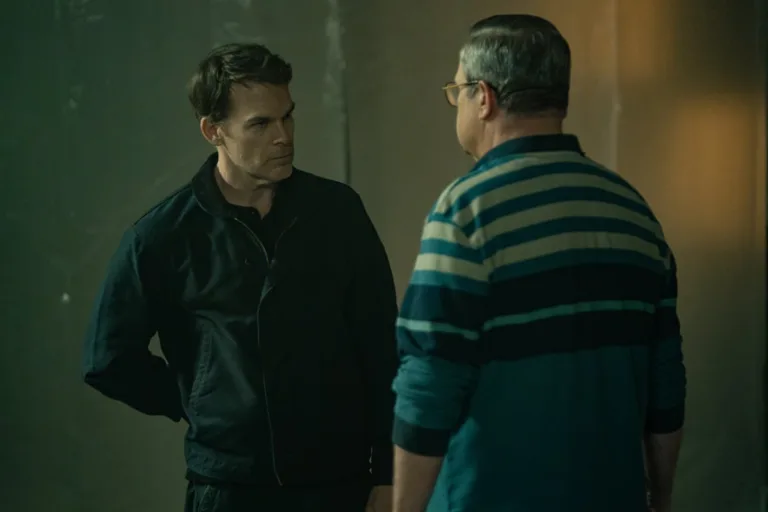
They agree to meet at an old body shop. Dexter prepares a kill room and displays Al’s trophies, but the reunion does not become the controlled execution he expects. Al realizes Dexter has taken the ponytails, and the encounter turns into a struggle.
Ending Explained: Dexter Wins Without Proving He Is Fine
Rapunzel nearly overwhelms Dexter, trapping him in plastic and forcing him to fight his way out. Dexter ultimately uses a chain hoist to hang Al. The immediate threat is over, but the means of surviving it exposes the weakness in Dexter’s approach.
He has successfully removed another killer, yet the confrontation is messier and more physically demanding than his preferred routine. Alongside his deteriorating eyesight, it gives substance to the question Harry raises about his risk-taking. Dexter is trying to reassure himself through action, and that need for reassurance is making the action less controlled.
The premiere does not show him becoming publicly celebrated, nor does it have him face either of the season’s new major adversaries. Those developments remain ahead. What it shows is a man winning a fight while accumulating reasons to doubt the judgment that put him there.
The closing arrival of Joey Quinn adds another pressure. Desmond Harrington’s detective comes to speak with Wallace about Batista, bringing Miami’s unfinished history into Dexter’s current city. The full consequences remain unresolved, but the return means Dexter’s old relationships cannot be kept safely inside his fantasies.
Final Verdict
“Risky Business” works because the season’s setup grows out of Dexter’s behavior. His aging body, envy of visibility and failure to attend Harrison’s graduation all point toward the same problem: he wants the benefits of a normal life and the satisfaction of his secret one, while resenting what each demands of him. Several returning and incoming characters receive only brief introductions, leaving much of the larger plot in preparation. Still, the premiere gives that preparation a clear emotional center. Dexter may be able to survive another hunt; whether he can accept what survival looks like is the more compelling question.
Dexter’s Need for Recognition Creates a New Risk
A darkly funny premiere connects Dexter’s changing limits to Harrison’s independence while preparing a crowded field of threats.
The conflict between Dexter’s need for secrecy and his growing desire to be appreciated.
Michael C. Hall’s restless Dexter, with Jack Alcott giving Harrison a stronger sense of direction.
The graduation disappointment, Batista fantasy and physically difficult Rapunzel confrontation.
The number of returning faces and incoming threats leaves several storylines at the introduction stage.
Dexter: Resurrection Premiere FAQ
How much time has passed since Season 1?
The premiere moves forward three years after the events surrounding Leon Prater.
Does Harrison join the police?
Yes. Harrison graduates from the police academy and begins a new chapter as an NYPD rookie.
What happens to Rapunzel?
Dexter kills Al Walker with a chain hoist after a struggle at an old body shop.
Is Batista alive?
No. His appearance in the premiere is part of Dexter’s imagination.
Does Dexter confront the new killers?
Not yet. The premiere introduces the New York Ripper and Five Borough Killer without bringing either face to face with Dexter.
Why does Quinn return?
He arrives to speak with Wallace about Batista. The premiere leaves the consequences of that visit unresolved.
Where to Watch Dexter: Resurrection
Dexter: Resurrection Season 2 premieres Friday, October 30, 2026, on Paramount+, beginning with “Risky Business.” Watch through the official series page. For the season announcement and cast information, visit TVLine’s release-date report.
More Dexter Coverage
Explore our Dexter coverage and TV Series Hub for recaps, news and promos.

Thomas Miller is the founder and Editor-in-Chief of Seat42F, covering television, movies and streaming entertainment. He launched Seat42F in 2007 and has spent nearly two decades covering the entertainment industry.