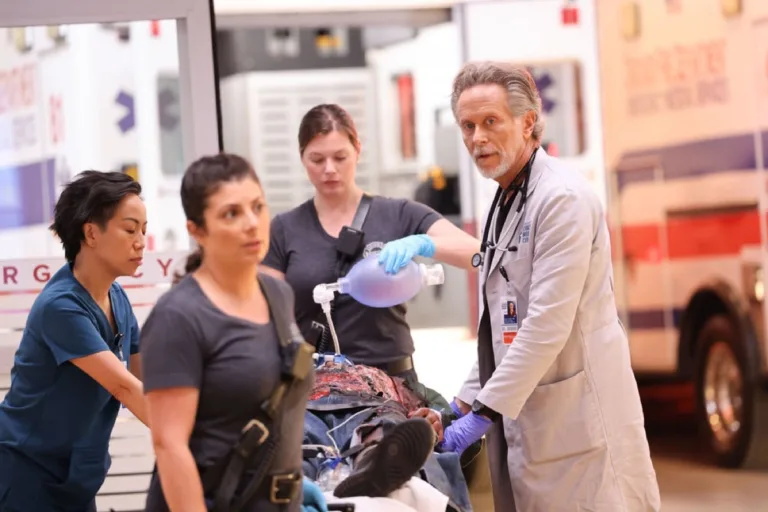
Chicago Med Season 12 Episode 2, “Third Rails,” ends with Sharon Goodwin surrendering her executive director position while finding another way to stay at Gaffney. Her resignation looks like a victory for the people pushing her out. Her decision to return to the emergency department as a charge nurse makes that victory considerably less comfortable.
S. Epatha Merkerson’s Goodwin remains central to the hospital’s political struggle, while Oliver Platt’s Daniel Charles, Steven Weber’s Dean Archer and Jessy Schram’s Hannah Asher face the consequences of patients’ dangerous choices. Darren Barnet’s John Frost and Luke Mitchell’s Mitch Ripley also have cases that test how much a doctor can understand before a patient is ready to explain.
The episode brings several emotionally difficult stories into the E.D. at once. Some connect more convincingly than others, but the strongest moments share a concern: patients and staff need someone who will keep listening after the obvious explanation stops being useful.
Goodwin Weighs Doris’ Confession and Miranda’s Deal
Goodwin begins the hour knowing Doris leaked the medical file at the center of the scandal. Doris acted in an effort to protect Charles, but her confession has left Goodwin facing another painful choice about the hospital and the people working there.
She consults her eldest son, David, for legal advice. Doris wants to come forward, but Goodwin worries that admitting to the leak could destroy her nursing career. David points out the danger of fighting the dispute through legal proceedings: an investigation would eventually reach Doris, and her guilt makes it unlikely she could keep the truth hidden. Protecting her becomes an important part of Goodwin’s decision.
Eventually, she accepts the deal and resigns as executive director. Taken on its own, that decision is frustrating. Goodwin is the person the hospital needs, and the confession has given her information that should change the balance of the dispute. The choice has an understandable personal motive in protecting Doris, but it still carries a professional cost. Goodwin is giving up the authority she could use to challenge the hospital’s direction.
The closing reveal supplies her answer: she intends to remain inside Gaffney as the E.D.’s charge nurse. She loses her executive role, but she keeps a place among the staff and patients affected by the new leadership’s decisions.
It is a substantial change in how she can act. The episode gives her a reason to stay involved and an ally in Archer. Whether she can turn that access into meaningful influence is still an open question.
Subway Surfing Brings a Devastating Loss
The emergency department receives several patients injured while subway surfing. The immediate danger is severe, and the injuries soon lead to a loss that the surviving patients will have to live with.
Nolan dies despite the medical team’s efforts. His brother Christian is also seriously injured and needs surgery. Christian already feels responsible for what happened, which makes the question of when to tell him about Nolan particularly difficult.
Frost and Christian’s father withhold the news before the operation. Their reasoning is understandable: Christian is about to undergo a dangerous procedure, and adding acute grief could make an already unstable situation worse. Yet postponing the conversation does not prevent him from sensing that something is wrong.
When his father reacts emotionally to Christian talking about Nolan, Christian becomes distressed. The scene catches the limits of a protective lie. A reassuring explanation can conceal the facts for a few minutes, but a frightened patient may still recognize the grief in the room.
Christian survives surgery. That is a relief, although it cannot give the family a happy ending. Nolan is still dead, and Christian’s recovery will include learning to live with his brother’s loss. Frost’s role in the case becomes about more than treating injuries: he must help a vulnerable young person through circumstances that medicine cannot repair completely.

Hannah and Abrams Face Samara’s Refusal
Hannah and Sam Abrams have another injured patient whose willingness to accept treatment becomes the central obstacle. Samara faces a frightening prognosis and refuses surgery because she may be left unable to walk. The consequences of refusing treatment are potentially fatal, but that warning does not immediately change her mind.
Leeches provide an unusual temporary treatment while the doctors continue trying to get her to agree to surgery. The detail is memorable, but the emotional problem matters more than the novelty. Samara cannot see an acceptable future in the choices being put before her.
Hannah reaches out to Samara’s mother, hoping she can help. Instead, her mother expresses exhaustion with Samara’s repeated dangerous behavior. That response adds to the sense that Samara is facing the decision without the support Hannah hoped to find for her.
Hannah ultimately makes a direct appeal that emphasizes Samara’s life and the courage involved in choosing to continue. Samara agrees to surgery. Her consent is the important resolution here; the episode does not need to turn that decision into a promise of an uncomplicated recovery.
The story gives Hannah a strong opportunity to advocate for a patient who is struggling to imagine life after injury. It also leaves room for a fuller mental health response. Samara’s willingness to risk death deserves sustained attention beyond the successful effort to obtain consent.
Charles Finds the Fear Behind Ellen’s Behavior
Ripley and Charles treat Ellen, whose rapid weight gain and medical problems initially point them toward questions about eating. The explanation becomes more complicated when they learn she has been trying to qualify for a GLP-1 prescription because she believes it could help control her drinking.
Ellen is dealing with an alcohol problem and fears the effect disclosure could have on a custody dispute involving her son. With her money going toward legal fees, she cannot afford to pay for the medication herself. She deliberately gains weight in an effort to obtain coverage, placing her health at risk while trying to find a way to manage her drinking. That financial pressure makes her behavior more comprehensible, even as the plan creates another medical crisis.
Ripley’s conversation with her young son contributes to the investigation. Learning that Ellen prepared the child to call for emergency help reminds him of his own childhood and his mother’s addiction. That connection gives the case a personal significance for him.
The clue needs careful handling. Teaching a child to call 911 does not establish that a parent has an addiction. As a dramatic prompt for Ripley to ask more questions, it works; the actual conclusion depends on the larger conversation with Ellen.
Charles’ best contribution comes once her fear is understood. He gains her trust and makes clear that medication cannot do all the work of addressing the underlying problem. The case is most effective when it focuses on the pressure Ellen feels to conceal her drinking and the difficulty of admitting she needs help.
The reveal arrives quickly, leaving less time than the story needs to connect her initial presentation to her eventual disclosure. Still, it gives Platt and Mitchell an opportunity to show how a conversation can change the direction of care.
Archer Pushes Back Against the Overflow Policy
Archer’s frustration with Sloan grows as the hospital’s overflow arrangements complicate patient care. The policy may create somewhere to put people, but his concern is whether those patients are receiving the attention they need.
Christian’s move into the overflow area makes that concern concrete. He needs a higher level of care, and the delay in getting him to the appropriate unit creates another threat to his recovery. For Archer, the existence of another room does not solve a staffing or monitoring problem. His objections reflect what he sees happening to patients, even if Sloan dislikes how he raises them.
His eventual apology initially seems to soften the dispute. The ending gives it another purpose: Archer has been working with Goodwin on the plan to bring her into the E.D. as charge nurse.
That cooperation is a promising development. Archer knows the department needs practical support, and Goodwin has both clinical experience and the staff’s trust. Their alliance could become the most useful part of her new position, provided the series gives them a credible way to challenge decisions that endanger care.
Hannah’s Return Includes a Familiar Parental Worry
Amid the larger emergencies, Hannah and Archer also deal with leaving their baby at daycare. The small domestic thread gives Hannah’s return to work an emotional complication that does not require another major crisis.
Her reluctance to separate from her child sits naturally alongside a day spent treating injured young people. By the time she collects her baby, that reunion carries the weight of everything she has encountered at work.
It is a useful reminder that the doctors take those experiences home. Hannah can do her job and still find the separation difficult; neither feeling cancels the other.
Final Verdict
“Third Rails” works best through individual acts of care: Frost trying to protect Christian, Charles encouraging Ellen to be honest, and Hannah refusing to give up on Samara. Those scenes give the hour a clear emotional foundation even when the cases move through their revelations too quickly.
Goodwin’s new job is an intriguing change with unresolved practical questions. Keeping her close to patients creates opportunities for the character, but the show still has to explain how reduced authority will help her confront Miranda and Sloan. The ending starts a new strategy; it has yet to prove that strategy effective.
The result is a busy, uneven episode with meaningful patient stories and a consequential shift for one of the series’ central figures. Goodwin is staying in the fight, and the next challenge is making her new position feel as credible as her commitment to the hospital.
Goodwin Finds a Way to Stay
Compassionate patient stories carry an uneven hour that sends Goodwin back to the E.D. with a new role and an unfinished fight.
Goodwin reveals that resigning as director does not mean leaving Gaffney.
Jessy Schram gives Hannah’s patient advocacy and return to work a personal connection.
Christian’s emotional ordeal and Charles’ effort to understand Ellen’s fear.
Some rushed case revelations and unanswered questions about Goodwin’s strategy.
“Third Rails” Ending Explained: Is Goodwin Leaving Gaffney?
Goodwin resigns as executive director and accepts Miranda’s deal, but she is staying at Gaffney as a charge nurse in the emergency department. Archer helps arrange the move. It lets her remain involved in patient care and support the staff while she continues opposing what is happening at the hospital.
Her new role does not restore her former authority or resolve the scandal. Her concern that a legal fight could expose Doris helps explain her choice. The ending establishes Goodwin’s intention to keep fighting rather than showing that Miranda has been defeated.
The patient stories have different outcomes. Nolan dies, while Christian survives surgery. Samara agrees to the operation after Hannah’s appeal. Ellen’s hidden alcohol problem comes to light, allowing Charles to address the issue beneath her attempt to obtain medication.
What is Goodwin’s new job?
She returns to Gaffney’s emergency department as a charge nurse after resigning as executive director.
Does Nolan survive?
No. Nolan dies, while his brother Christian survives surgery.
Does Samara agree to surgery?
Yes. Hannah’s appeal helps persuade her to accept treatment after she initially refuses.
When is the next Chicago Med episode?
Season 12 Episode 3, “They Call Me Ms. Goodwin,” airs Wednesday, October 21, at 8/7c on NBC.
When Does Chicago Med Return?
Chicago Med Season 12 Episode 3, “They Call Me Ms. Goodwin,” airs Wednesday, October 21, 2026, at 8/7c on NBC. The episode streams Thursday, October 22, on Peacock. “Third Rails” becomes available Thursday, October 15, through the official Chicago Med page on Peacock.
Revisit our “Third Rails” episode photos for more from the hour.
More Chicago Med Coverage
Explore our Chicago Med recaps, episode photos and news, plus more from Chicago Fire and Chicago P.D.

Thomas Miller is the founder and Editor-in-Chief of Seat42F, covering television, movies and streaming entertainment. He launched Seat42F in 2007 and has spent nearly two decades covering the entertainment industry.