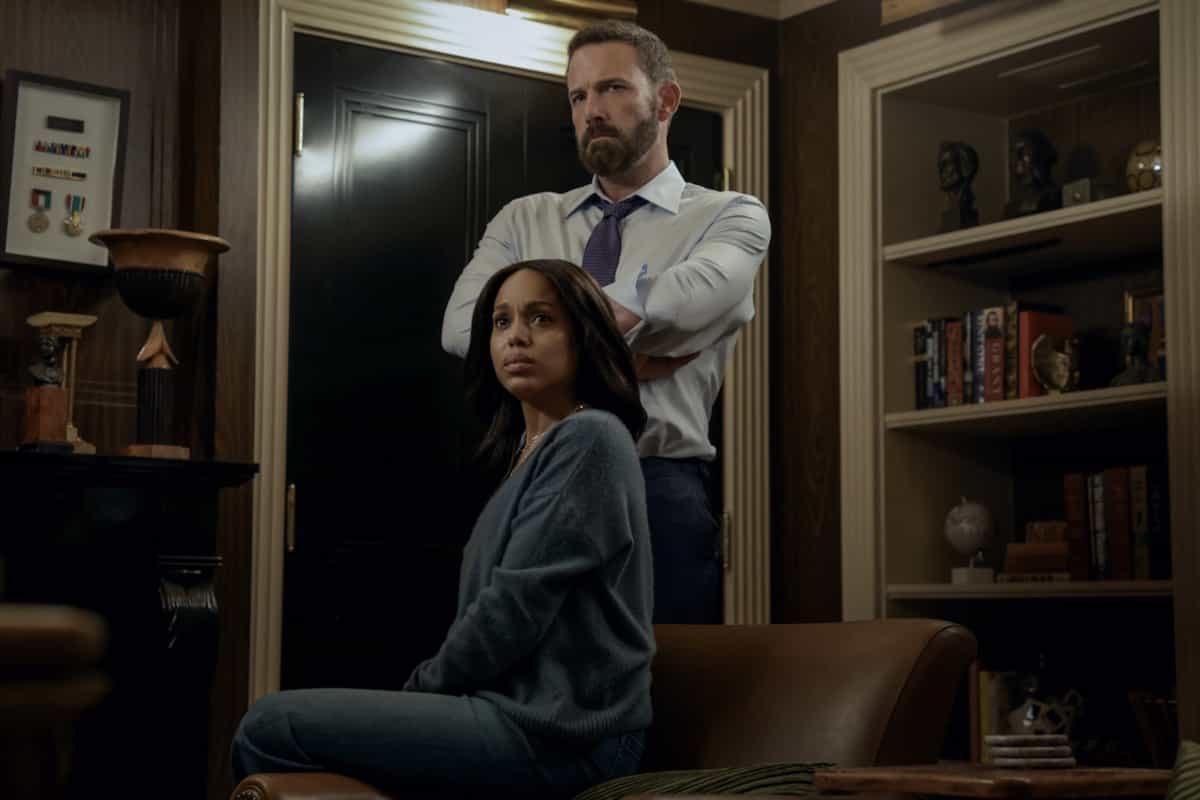
Animals puts Ben Affleck back behind the camera and in the middle of a crisis that money and influence cannot easily solve. His Netflix thriller stars Affleck and Kerry Washington, with Gillian Anderson, Steven Yeun, Adriana Paz and Luis Gerardo Méndez completing an ensemble built for uncomfortable decisions. The result is an uneven film with an intriguing moral question and enough acting talent to keep its shortcomings from becoming the whole story.
Affleck plays Mark Kimball, a candidate for mayor of Los Angeles. Washington is his wife, Abigail. A threatening call turns an already difficult period in their lives into a desperate scramble to raise a ransom. Their campaign aide, Sam, and fixer Dayle Burton become involved as the couple tries to manage a situation that keeps exposing the limits of their control.
The attraction is immediate: a politician accustomed to presenting himself as the right person for the job must make decisions without the protection of a campaign message. Unfortunately, Animals is more compelling in that premise than consistently persuasive in its execution.
Light Spoiler Notice
This review discusses the setup, performances and themes of Animals. Major twists and the ending are left unrevealed.
A Crisis That Tests the Campaign Promise
The most interesting question in Animals concerns the relationship between public principle and private choice. Mark has a version of himself that he wants voters to accept. The crisis puts pressure on that version, asking whether his convictions remain useful when acting on them could cost him something he values.
This is fertile material because political hypocrisy does not have to begin with a person knowingly lying. Someone can believe a flattering account of their own character until circumstances require proof. The gap between belief and action is where a thriller about a candidate can become more unsettling than a straightforward story about corruption.
Here, however, the screenplay does not always give its central figure enough complexity to sustain that promise. Mark’s predicament suggests difficult moral territory, but the film’s construction often makes the characters feel subordinate to the next complication. A plot can keep adding information without making the people caught inside it more revealing.
That is the central disappointment. The premise invites us to weigh a person’s decisions, and the dramatic machinery too often keeps us occupied with how the story will arrange its next turn.
The Marriage Gives the Threat a Second Dimension
Mark and Abigail enter the crisis with problems of their own. Their relationship matters because the people who must make urgent decisions together do not begin from a position of complete trust. Washington’s character is more than an accessory to a campaign: she has a life, responsibilities and frustrations that exist beyond Mark’s ambitions.
The marriage gives the film a useful distinction between being publicly aligned and privately understood. A couple can appear united while disagreeing about what each has sacrificed. An emergency does not erase that history; it can make every unresolved grievance harder to put aside.
The limitation is that marital conflict and suspense do not always reinforce each other. Arguments should change what the couple can accomplish, or make a decision more painful. When they primarily supply another round of revelations, the emotional material begins competing with the urgency instead of deepening it.
Gillian Anderson Gives the Ensemble Its Sharpest Presence
Anderson is the standout as Dayle, whose composure brings a different rhythm to the crisis. Her authority supplies an effective counterweight to the surrounding distress. A person who can remain composed while others panic naturally becomes someone the audience watches closely.
Affleck and Washington give the central situation recognizable emotional stakes, while Yeun’s campaign aide adds the calculating perspective of someone whose job is to manage consequences. The ensemble provides a reason to stay engaged even when the narrative becomes less convincing.
Dayle is particularly valuable because a thriller does not need every character to announce the danger at the same volume. Restraint can create uncertainty of its own. Anderson’s presence offers the film something its busier passages need: a character whose control makes the room feel different.
Affleck’s Direction Cannot Fully Resolve the Script’s Problems
Much of Animals takes place inside the Kimballs’ home. Affleck has described the house as an expression of their status: expensive, yet arranged to project a degree of modesty. That contradiction suits a story about people who want wealth and influence without always acknowledging what those advantages mean.
The setting also offers a natural dramatic trap. A comfortable home can become a place where there is nowhere to escape a conversation. The rooms that ordinarily protect privacy become the spaces in which that privacy breaks down.
Yet the film’s momentum is inconsistent. The middle stretch loses urgency, and restless camerawork around conversations cannot supply all the tension that the writing leaves missing. More movement does not necessarily mean greater pressure.
The film also invites comparison with High and Low, whose kidnapping premise connects money to moral responsibility. That resemblance should be understood as a critical comparison, rather than an announced adaptation credit. It places a demanding standard beside Animals: the thriller needs to make its social questions felt through choices, not merely introduce them as subjects.
Final Verdict
Animals offers enough intrigue and acting ability for viewers drawn to a political thriller, but it falls short of the sustained tension its premise promises. The cast gives the film weight, especially Anderson, while the storytelling repeatedly asks for more patience than its suspense earns.
There is a worthwhile idea here about the stories people tell to protect their sense of themselves. The film would be stronger if it trusted that idea—and the actors carrying it—with fewer complications. It is a qualified option for a Netflix movie night, with expectations best set around an uneven thriller rather than a major return to form.
A Strong Cast, an Uneven Grip
Animals offers intriguing moral territory and a standout Gillian Anderson, but struggles to turn its complications into sustained suspense.
Dayle’s arrival bringing a different rhythm to the crisis.
Gillian Anderson as fixer Dayle Burton.
The ensemble and the clash between private choices and public principle.
Uneven urgency and complications that outpace the character development.
Animals Cast and Creative Team
Ben Affleck directs, co-writes and stars in Animals. The screenplay is credited to Affleck, Connor O. McIntyre and Billy Ray. Robert Elswit serves as cinematographer.
The principal cast includes Affleck as Mark Kimball, Kerry Washington as Abigail Kimball, Gillian Anderson as Dayle Burton, Steven Yeun as Sam, Adriana Paz as Cecilia Trujillo and Luis Gerardo Méndez as Ramon.
SEAT42F • ANIMALS FAQ
Does Ben Affleck direct Animals?
Yes. Affleck directs and stars, and shares screenplay credit.
How long is Animals?
Netflix lists the film at approximately 1 hour and 48 minutes. It is rated R.
Is this review spoiler-heavy?
No. It discusses the premise and filmmaking without revealing the major twists or resolution.
Where to Watch Animals
Animals premiered Friday, October 9, 2026, and is now streaming on Netflix. For more about the production, read Netflix’s interview with Ben Affleck.
MORE MOVIE COVERAGE
Explore Seat42F’s Netflix coverage for film and series news, trailers and reviews, and follow our Ben Affleck coverage for more from the actor and filmmaker.

Thomas Miller is the founder and Editor-in-Chief of Seat42F, covering television, movies and streaming entertainment. He launched Seat42F in 2007 and has spent nearly two decades covering the entertainment industry.