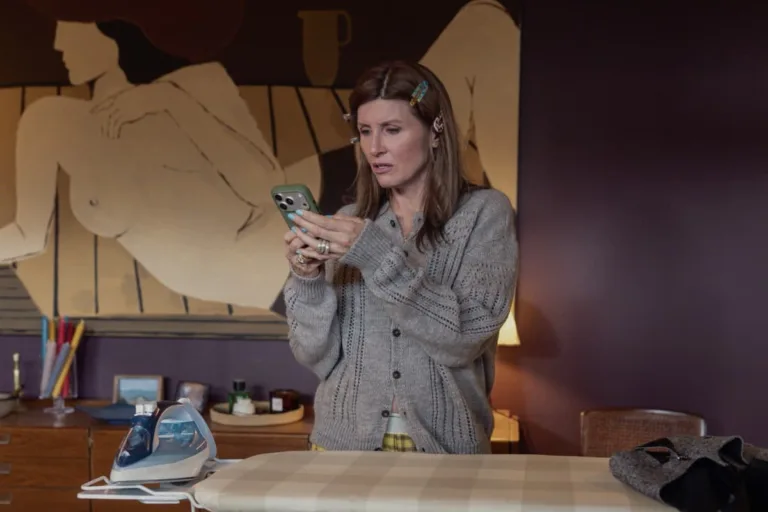
Sharon Horgan has built a career out of making emotional chaos funny without making it feel small, and Youth gives her one of her sharpest, messiest characters yet. HBO’s new comedy stars Horgan as Alex, a divorced London literary agent facing a perfect storm of middle-aged uncertainty: her son is about to leave for university, her parents need more care, her dating life is stalled and the younger versions of the life she imagined have somehow gone on without her.
Based on its first two episodes, Youth is funny, rude, uncomfortable and much more tender than its title initially suggests. Horgan plays Alex with the particular kind of high-functioning panic she does so well—a woman who can give professional advice, manage other people’s emergencies and keep a conversation moving right up until she has to confront what she actually wants. The show also stars Aran Murphy as her uneasy, soon-to-be college-bound son Ruarí, Sharlene Whyte as Alex’s friend and boss Sam, Rupert Friend as a former flame and Owen McDonnell as Alex’s ex-husband.
Youth Makes Middle Age Feel Urgent, Not Settled
The title is the joke and the point. Alex is 50, not 20, but Youth is interested in the strange way adulthood keeps rearranging itself just when you think you have reached a stable version of it. Her son is preparing to leave home. Her parents are becoming less independent. The romantic options around her come with baggage, history or an unnerving reminder of how differently aging is judged depending on who is doing it. Alex’s life is full, yet she is painfully aware that much of it has been arranged around everyone else’s needs.
Horgan never turns that tension into a tidy “reinvention” story. Alex is vain, impulsive, funny and often plainly wrong. She can be cruel when embarrassed, self-absorbed when frightened and uncomfortably competitive when she sees other people moving through the world with an ease she no longer feels. That is exactly why she works. Horgan has always been exceptionally good at writing women who are difficult in recognizable ways, and Alex’s worst decisions are not softened into inspirational lessons. The show trusts that viewers can wince at her and still understand her.
The first two episodes find humor in physical mishaps, disastrous social exchanges and the indignities of a body that has stopped following old rules. But the comedy is not simply there to take the edge off the sadness. It is how Alex survives it. A dating disappointment, a fight with Ruarí or an office humiliation becomes funny because it lands on an already overloaded person trying desperately to hold onto a version of herself she still recognizes.
Sharon Horgan Is the Reason to Watch
Horgan’s performance is the show’s center of gravity. She makes Alex’s frustration feel specific rather than generically “midlife,” and she knows how to let a look or a slightly delayed response do as much work as a speech. The character’s longing for sex, love, relevance and simple quiet is not treated as a punchline. What is funny is the gap between Alex’s self-image and the reality of trying to pursue any of those things while her family and work life keep making demands on her.
Murphy gives Ruarí more sensitivity than his initially exasperating behavior might suggest. He is at an age where he wants freedom from his mother while still depending on her in ways neither of them can say cleanly, and the two actors make that push-and-pull feel lived in. Whyte is equally important as Sam, the friend who shares Alex’s shorthand and history but also has power over her professional life. Their relationship gives the show a useful complication: Sam is neither a villain nor an uncomplicated ally, and the conflict between friendship and ambition feels rich enough to keep deepening.
The supporting men are drawn with Horgan’s usual willingness to let charm coexist with selfishness. Friend brings a loose, unreliable energy to Patrick, while McDonnell makes Alex’s ex feel like a person who has not entirely left her emotional orbit. The literary-agency setting gives the series another source of acid humor, too. This is a world full of clients, manuscripts, career insecurities and people who use candor as both a weapon and a personality trait.
Youth Balances the Cringe With Real Feeling
There are moments in the first two episodes where Youth pushes hard into embarrassment. A few scenes are designed to make viewers hide behind a cushion, and Alex’s self-sabotage can be exhausting by design. The show’s confidence is that it does not retreat from those moments too quickly. It lets a bad choice sit there, then finds the hurt underneath it. That balance is what separates the series from a looser collection of dating and family jokes.
If there is a limitation this early, it is that Alex is so vividly realized that some of the people around her initially function more as sources of pressure than as characters with equally clear inner lives. Ruarí and Sam already have room to grow, but Alex’s parents and several peripheral figures feel sketched in more broadly. It is not a serious problem at this point, and the show’s half-hour rhythm keeps the episodes brisk, but it is the area where later installments have the most opportunity to expand.
What is already clear is that Youth understands the unnerving contradiction at the heart of its premise. Being older can mean knowing yourself better, yet it can also mean realizing that time, health, family and desire are all moving on their own schedules. Horgan makes that realization hilarious, humiliating and occasionally heartbreaking—often in the same scene.
Final Verdict
Youth is a very strong start: a caustic, emotionally alert comedy powered by Sharon Horgan’s fearless lead performance. The first two episodes are laugh-out-loud funny, but they also establish a real emotional stake in Alex’s attempt to claim a life that belongs to her rather than simply manage everyone else’s. Fans of Catastrophe, Bad Sisters and Horgan’s brand of beautifully uncomfortable comedy should make this an easy watch.
A Midlife Crisis With Bite
Sharon Horgan turns divorce, family pressure and the terror of starting over into a viciously funny, emotionally precise comedy.
Alex trying to reclaim some control of her own life, only for the world to have other ideas.
Sharon Horgan, fearless about letting Alex be funny, selfish, vulnerable and wrong.
Brutal jokes, Horgan’s lived-in lead performance and a sharp look at the anxieties of middle age.
A few supporting characters need more definition beyond the pressure they place on Alex.
Where to Watch Youth
Youth premiered Sunday, September 20, 2026, on HBO and is streaming on HBO Max. The first two episodes are available now. The eight-episode season continues with new episodes Sundays at 10:00 p.m. ET/PT on HBO, with streaming availability on HBO Max.
MORE HBO MAX COVERAGE
Explore Seat42F’s latest HBO Max news, trailers, reviews and previews for more from HBO and the streaming service.

Thomas Miller is the founder and Editor-in-Chief of Seat42F, covering television, movies and streaming entertainment. He launched Seat42F in 2007 and has spent nearly two decades covering the entertainment industry.