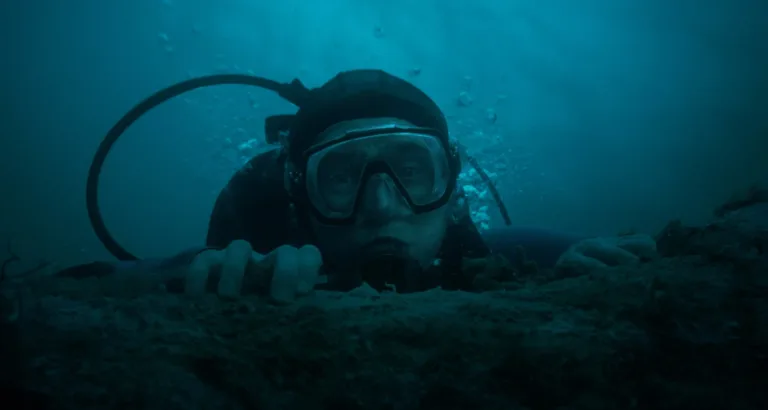
Whalefall has a premise that can sound like a dare: put a diver inside a sperm whale and see whether a feature-length thriller can follow him out. Director Brian Duffield takes that challenge seriously, building a film around the physical terror of confinement and the emotional burden its protagonist carries underwater. Austin Abrams stars opposite Josh Brolin, with Elisabeth Shue, John Ortiz, Jane Levy and Emily Rudd completing the principal cast.
The result is an absorbing, sometimes uneven combination of survival suspense and family drama. Abrams supplies the essential connection between those two halves. Even when the symbolism becomes emphatic, his vulnerability gives the film something more immediate to hold onto: a frightened person trying to make the next decision before his options disappear.
A Simple Premise With Complicated Feelings
Abrams plays Jay Gardiner, who dives off the California coast in search of his late father’s remains. His father, Mitt, played by Brolin, was an accomplished diver and a difficult parent. The expedition carries grief, resentment and unfinished business before Jay encounters the enormous animal that will turn his search into a fight for survival.
Swallowed by a sperm whale with about an hour of air remaining, Jay has a problem that needs no elaborate explanation. He must understand an unfamiliar environment while protecting the equipment keeping him alive. Duffield and co-writer Daniel Kraus, adapting Kraus’ novel, make the remembered relationship with Mitt part of that practical struggle.
That connection is the film’s central gamble. The man Jay has struggled to understand also taught him things he now needs. Remembering a useful lesson does not erase the circumstances in which it was learned. The story has room for that contradiction, although its desire to underline the emotional meaning can make the relationship feel more neatly organized than the pain behind it.
Austin Abrams Makes the Impossible Feel Immediate
Abrams is the strongest reason to follow this extraordinary predicament. Jay is no effortless adventurer who becomes calmer as circumstances worsen. Fear interferes with his thinking, physical discomfort limits his movements, and surviving one problem offers no assurance that he can manage the next.
Much of the performance must register through his eyes and body, with diving equipment obscuring his face and restricting his speech. That limitation makes his reactions especially important. A moment of hesitation can communicate the distance between knowing that he must act and believing that an action might work. The scenes on land supply another dimension: Jay’s withdrawal reads as a means of protecting himself, making the emotional distance between father and son more understandable.
There is also value in how little glamour the role allows. Jay’s distress is exhausting and undignified, which gives the thriller a useful vulnerability. The audience does not need to believe it could master this environment. It needs to recognize the impulse to keep trying while overwhelmed, and Abrams makes that impulse accessible.
The Whale Becomes a Disturbing Setting
The confined environment gives Whalefall its most distinctive filmmaking. Space is difficult to read, movement becomes an effort, and the surroundings can change without regard for what Jay needs. The whale is a living creature rather than a room with a conveniently fixed layout.
Production design and visual effects make the setting both tactile and strange. The contrast with the ocean outside is particularly useful: open water presents an intimidating scale, while the interior makes even a small amount of movement feel consequential. Sound adds another layer of separation from anything resembling ordinary human space.
The film’s strongest suspense comes from that loss of orientation. A dwindling supply of air is easy to grasp; deciding what to do in a place that offers no familiar landmarks is harder. The scenario turns basic bodily needs into sources of tension without requiring a conventional villain to explain the danger.
Josh Brolin Gives the Memories Their Weight
Brolin’s Mitt is a forceful presence whose ease around other people contrasts with his difficulty reaching his son. His authority can become overbearing, but Brolin gives that hardness a vulnerability that keeps Mitt from functioning only as an obstacle in Jay’s past. The flashbacks bring a different pressure to the film, replacing immediate danger with expectations Jay has carried for years.
There is a meaningful difference between giving a difficult parent complexity and explaining away the harm he caused. Whalefall is most persuasive when it permits affection and anger to occupy the same memory. Its less assured passages push toward emotional significance so strongly that the characters can seem to be serving the metaphor.
The supporting cast broadens the family context, but Jay and Mitt dominate the drama. Viewers primarily drawn by Shue, Levy, Rudd or Ortiz should expect a film organized around Abrams’ ordeal and the father-son relationship rather than an evenly distributed ensemble story.
Where the Film Loses Some Momentum
The shifts between immediate peril and recollection will be the dividing point for many viewers. A memory can deepen a decision or provide a needed pause. Repeated emotional explanation can also interrupt a situation whose urgency has already been established.
The film’s sincerity is appealing, but sincerity does not automatically make every dramatic passage equally effective. At times, the connection between physical confinement and emotional struggle is clear before the screenplay finishes emphasizing it. Those passages soften the pressure that the more direct survival scenes build so effectively.
Still, the willingness to pursue both ideas gives the movie character. Duffield commits to a strange, uncomfortable premise without treating it as a joke that excuses thin characterization. The awkward moments come from trying to give the experience meaning, and Abrams provides enough human detail to keep that ambition engaging.
Final Verdict
Whalefall is a tense, visually distinctive thriller carried by Austin Abrams’ committed performance. Its family drama occasionally presses too hard, and the transitions between reflection and danger are not always smooth. Yet the confined setting, physical vulnerability and earnest approach give it an identity beyond its unusual hook. For viewers comfortable with claustrophobia and bodily distress, it offers an unsettling theatrical experience with an emotional question beneath the spectacle.
Abrams Gives the Nightmare a Human Center
A committed Austin Abrams and an unsettling setting sustain this ambitious thriller, even when its family drama becomes too insistent.
The claustrophobic survival sequences and their tangible physical stakes.
Austin Abrams as Jay Gardiner.
Physical acting, immersive design and an unusually earnest approach.
Uneven transitions between immediate danger and emotional reflection.
What is Whalefall about?
A diver searching for his late father’s remains is swallowed by a sperm whale and must find a way to survive with limited air.
Who stars in Whalefall?
Austin Abrams, Josh Brolin, Elisabeth Shue, John Ortiz, Jane Levy and Emily Rudd.
Is Whalefall based on a book?
Yes. Brian Duffield and Daniel Kraus adapted Kraus’ novel, with Duffield directing.
What is Whalefall rated?
The official U.S. rating is PG-13. The film nevertheless includes intense peril and disturbing bodily imagery.
Where can you watch Whalefall?
Whalefall opened in U.S. theaters October 16, 2026. No home-streaming date is confirmed in the official materials checked for this review.
Where to Watch Whalefall
Whalefall is now playing in U.S. theaters following its October 16, 2026 release. Visit the official 20th Century Studios film page for the trailer and ticket information. For more on adapting the novel and creating the confined sets, read Disney’s interview with the filmmakers.
More Movie Coverage
Explore Seat42F’s movie coverage for more reviews, trailers and film news.

Thomas Miller is the founder and Editor-in-Chief of Seat42F, covering television, movies and streaming entertainment. He launched Seat42F in 2007 and has spent nearly two decades covering the entertainment industry.