Paul Greengrass has spent much of his career making history feel like it’s happening right now.
With The Uprising, the director of United 93, Bloody Sunday and Captain Phillips travels farther into the past than ever before — all the way to England in 1381 — without abandoning the restless, ground-level filmmaking that has defined his work.
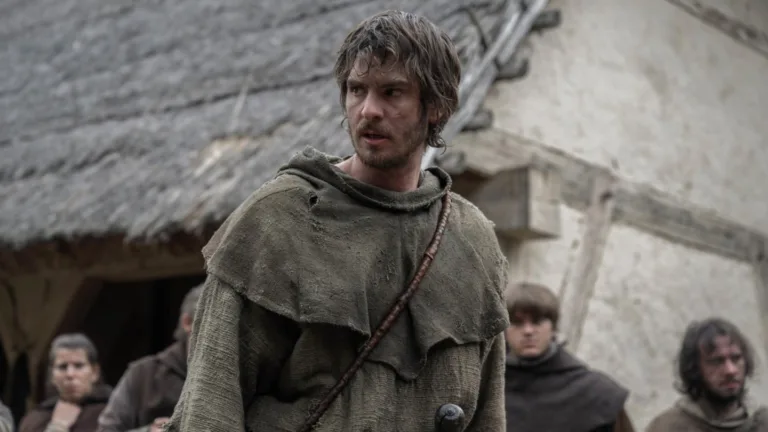
Andrew Garfield stars as a grieving farmer known simply as Ploughman, one of countless ordinary people struggling to survive in a country devastated by the Black Death and squeezed by a ruling class demanding increasingly punishing taxes.
When that pressure finally becomes unbearable, frustration turns into resistance.
Then resistance becomes revolution.
Greengrass, who also wrote the screenplay, uses the real Peasants’ Revolt as the foundation for a violent historical epic about people discovering that accepting injustice and surviving it aren’t necessarily the same thing.
The history gets considerably messier as The Uprising progresses, and the film occasionally reaches for mythology when reality was compelling enough.
But when Greengrass puts us among the frightened, furious people marching toward London, The Uprising is difficult to look away from.
Andrew Garfield Makes Ploughman an Everyman Worth Following
Garfield’s character doesn’t begin the movie dreaming of revolution.
Ploughman is barely surviving.
His wife and children died during the Black Death, leaving him alone on land he works but doesn’t truly control. He’s exhausted, grieving and accustomed to a system in which people like him exist largely to provide for people born above them.
Then another tax arrives.
The population has already been decimated by plague. Workers are scarce. Food and money are scarce. England remains at war.
Yet the people who have sacrificed the most are once again expected to pay.
Ploughman finally reaches his limit.
Garfield is particularly effective because he doesn’t initially play him as a natural revolutionary. There’s an uncertainty underneath the anger. Ploughman still believes in the idea of a king and in a social order that has been presented as divinely ordained.
He simply can’t reconcile that belief with what he sees happening around him.
That makes his transformation more compelling than if Greengrass had introduced him as a born rebel.
Garfield’s performance is understated compared with several people surrounding him, but that works. Ploughman becomes our way into a movement much bigger than one man.
Cosmo Jarvis and Jamie Bell Bring Fire to the Rebellion
If Garfield supplies the wounded humanity, Cosmo Jarvis and Jamie Bell provide much of the fire.
Jarvis plays Wat Tyler, the historical leader who emerges as one of the revolt’s most important figures. He’s forceful and intimidating but also understands that thousands of angry people aren’t automatically an organized movement.
Bell plays radical priest John Ball, whose arguments about equality give the rebellion something more powerful than anger.
Ideas.
The distinction matters.
The rebels don’t all want precisely the same thing. Some want relief from taxation. Others want fundamental changes to the social order. Some remain deeply loyal to the king while despising the people advising him.
Greengrass allows those contradictions to remain messy.
The rebellion isn’t presented as an army suddenly united behind a perfectly articulated political philosophy. It’s a collection of people who know their lives have become intolerable even if they don’t always agree about what should replace the system they’re challenging.
Jarvis and Bell thrive in that environment, giving the film two performances considerably louder than Garfield’s without overwhelming him.
Thomasin McKenzie also brings vulnerability as Alyce, another survivor whose losses draw her toward Ploughman as the rebellion grows.
The Uprising Makes Medieval England Feel Frighteningly Immediate
Nobody is going to mistake The Uprising for a stately costume drama.
Greengrass brings his familiar handheld camera into medieval England, frequently placing viewers directly inside crowds, confrontations and bursts of violence.
Sometimes it feels less like watching history than watching someone documenting a riot while trapped inside it.
That approach can be exhausting.
It’s also extremely effective.
Weapons don’t produce elegant choreography. Crowds don’t move in perfect formation. Violence erupts suddenly and becomes chaotic almost immediately.
People get frightened.
Plans collapse.
Nobody has a complete view of what’s happening.
The result is a medieval rebellion filmed with the nervous energy of a modern political uprising.
The Los Angeles Times similarly praises the decision to apply Greengrass’s modern, almost documentary-like visual language to the Peasants’ Revolt, while noting how Garfield’s performance gives viewers an emotional compass once events descend into chaos.
There are moments when the technique becomes too much. Greengrass has never been shy about moving a camera, and viewers who dislike his trademark “shaky cam” aren’t going to suddenly become converts here.
But at its best, the approach eliminates the comfortable historical distance between the audience and the people on screen.
Woody Norman Makes a Terrific Young King Richard II
The movie is smart enough not to spend all its time with the rebels.
On the other side is the teenage King Richard II, played by Woody Norman.
Norman is excellent.
Richard possesses enormous authority without necessarily possessing the experience or emotional maturity required to understand it.
Around him are powerful men determined to protect the existing order, including Tom Hollander as treasurer Robert Hales and Stephen Dillane as Archbishop Simon Sudbury.
Jonny Lee Miller appears as London mayor William Walworth, while Katherine Waterston plays Richard’s mother, Joan of Kent.
Cross-cutting between the rebels and the royal court allows Greengrass to show two completely different versions of England existing simultaneously.
For the peasants, another tax can mean hunger.
Inside the court, those same people can become numbers on a map.
That distance is one of the movie’s most effective sources of anger.
Norman never needs to turn Richard into a cartoon villain. A frightened teenager with enormous power and adults whispering into his ear is considerably more interesting.
The Black Death Hangs Over Everything
One of The Uprising’s smartest choices is treating the Black Death not as historical background but as something these characters are still living through.
Ploughman lost his family.
Entire communities have been hollowed out.
The surviving workers understand that their labor has become more valuable because so many others are dead, yet laws and social structures prevent them from benefiting from that new reality.
That tension makes the events of 1381 surprisingly contemporary without requiring Greengrass to underline every parallel.
A population emerges from catastrophe.
Economic inequality becomes harder to ignore.
People who kept society functioning discover that the people governing them expect life to return to the previous arrangement.
Eventually someone says enough.
The movie doesn’t need a speech explaining why audiences in 2026 might recognize pieces of that dynamic.
They’re already there.
Greengrass Sometimes Sacrifices Character for Momentum
The same urgency that makes The Uprising exciting also creates one of its biggest weaknesses.
The movie rarely stops moving.
Once the rebellion begins gathering momentum, characters, locations and political factions start arriving quickly.
That can make the historical details difficult to follow, particularly for viewers who don’t arrive with much knowledge of the Peasants’ Revolt.
Some characters function more as representations of an idea or social class than fully developed people.
Even Ploughman is intentionally constructed as an everyman.
That works thematically but occasionally leaves Garfield carrying emotional moments that the screenplay hasn’t fully earned.
At 2 hours and 8 minutes, the movie isn’t short, yet portions still feel strangely compressed.
The critical response has been divided along similar lines. The movie currently sits at 53% on Rotten Tomatoes, with praise frequently directed toward Garfield, the visceral filmmaking and performances, while criticisms focus on uneven storytelling and the way history and fiction eventually collide.
The Violence Is Brutal Without Feeling Heroic
The Uprising earns its R rating.
This is not romantic medieval combat.
Greengrass presents violence as ugly, frightening and frequently confusing.
That’s important because it prevents the rebellion from becoming a simple fantasy about righteous people defeating obvious villains.
Anger can motivate people toward justice.
It can also become something else once thousands of frightened people are moving together.
The movie understands both possibilities.
Greengrass is particularly good at showing how quickly a crowd can change character. One moment people are united by a shared grievance; the next, individual motivations and fear begin pulling them in different directions.
The battles aren’t really the point.
The people inside them are.
The Uprising Doesn’t Need to Become a Legend
Where the film becomes less convincing is when Greengrass starts reaching beyond the historical revolt itself.
The events of 1381 are already fascinating.
Real people challenged a deeply entrenched social hierarchy while still living within a culture that regarded monarchy very differently than modern audiences do.
That’s complicated material.
The Uprising sometimes seems uncomfortable allowing that complexity to stand on its own.
The screenplay increasingly gestures toward folklore and larger cultural mythology, and those choices don’t always sit comfortably beside the grounded historical drama Greengrass has built.
I’m deliberately leaving the specifics there.
The marketing itself acknowledges that the uprising depicted in the film helped inspire the legend of Robin Hood, but knowing more than that before seeing the movie diminishes something Greengrass clearly intends audiences to discover for themselves.
The frustrating part is that The Uprising doesn’t need the additional mythology.
A farmer standing up because he can no longer tolerate what is being done to the people around him is already enough.
Final Verdict
The Uprising is messy, exhausting and occasionally more interested in turning history into legend than the history requires.
It’s also frequently gripping.
Paul Greengrass takes a medieval revolt and strips away much of the comfortable distance that normally comes with period filmmaking. His handheld camera puts viewers among people who don’t know how their rebellion will end because, from their perspective, history hasn’t been written yet.
Andrew Garfield gives the movie a strong emotional center without turning Ploughman into a conventional action hero. Cosmo Jarvis and Jamie Bell bring tremendous energy to the rebellion, while Woody Norman is terrific as a young King Richard II struggling with power far greater than his maturity.
The film’s middle can become muddled, and its mixture of historical fact and invented mythology isn’t always convincing.
But Greengrass understands something more important.
Revolutions don’t begin as history.
They begin when enough ordinary people decide they can’t continue living the way they’ve been told they must.
For much of The Uprising, that anger feels frighteningly alive.
The Uprising
A messy but gripping medieval epic that turns Paul Greengrass’s documentary immediacy loose on the Peasants’ Revolt, anchored by an understated Andrew Garfield.
The rebellion beginning to swell from isolated frustration into a genuine movement, with Greengrass placing the audience directly inside its increasingly unpredictable momentum.
Andrew Garfield grounds the movie with a restrained performance that allows Ploughman to remain an ordinary grieving man even as history begins moving around him.
The visceral filmmaking, Garfield’s vulnerability, Cosmo Jarvis and Jamie Bell’s fiery supporting performances, and a medieval world that feels frighteningly immediate.
The middle becomes muddled, several characters remain thinly drawn, and the movie’s attempts to connect historical events with larger mythology aren’t as convincing as the revolt itself.
Where to Watch The Uprising
The Uprising is now playing in theaters. The Focus Features historical drama opened domestically on September 11, 2026. No streaming premiere date has been announced.
Follow Seat42F for more movie reviews, trailers, release dates, box office updates and film news.
See all movie coverage →

Thomas Miller is the founder and Editor-in-Chief of Seat42F, covering television, movies and streaming entertainment. He launched Seat42F in 2007 and has spent nearly two decades covering the entertainment industry.