Ridley Scott has spent much of his career imagining worlds where humanity is under threat, but The Dog Stars approaches the end of civilization from an unexpectedly gentle direction. Rather than another relentless survival thriller, Scott is more interested in what happens when surviving isn’t enough.
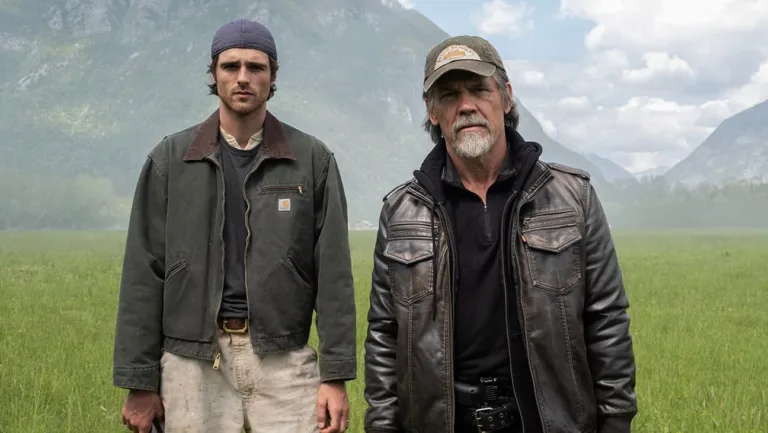
Jacob Elordi stars as Hig, a pilot still mourning the wife he lost to the pandemic that destroyed most of civilization. He shares an abandoned Colorado airport with his dog Jasper and Bangley, a heavily armed former Marine played by Josh Brolin. They’ve figured out how to stay alive. The problem is that Hig increasingly wonders whether their isolated existence actually qualifies as living.
That question gives The Dog Stars its best material. Unfortunately, Scott’s unusually restrained approach is paired with a screenplay that doesn’t always give its characters enough depth to sustain nearly two hours of contemplation.
The result isn’t the disaster some of the harsher early reviews suggest. There’s beauty here, along with an appealing streak of optimism and several strong performances. But for a movie about rediscovering reasons to live, The Dog Stars too often feels strangely lifeless.
Hig And Bangley Have Survived The End Of The World
Years after a devastating flu pandemic wiped out most of humanity, Hig and Bangley have created something resembling a functioning life at an abandoned airport in Colorado.
Hig flies an old Cessna, scouting the surrounding area and gathering supplies. Bangley handles security with the ruthless efficiency of a man who seems to have spent his entire pre-apocalypse life preparing for civilization to collapse.
It’s an effective pairing because Elordi and Brolin are playing two fundamentally different ideas about survival.
Bangley has everything he thinks they need: food, water, weapons and defensible territory. He’s alive, therefore the system works.
Hig needs something more.
He helps a nearby Mennonite community and continues searching for signs that decent people might still exist beyond the perimeter they’ve built. His optimism isn’t naïveté so much as a refusal to accept Bangley’s conclusion that humanity revealed its true nature when civilization disappeared.
Scott is clearly more interested in that philosophical divide than in inventing another elaborate post-apocalyptic mythology. There are no zombies here, something the director himself has emphasized while discussing the movie. Instead, The Dog Stars asks whether retaining compassion is a liability or the very thing that makes survival worthwhile.
That’s a worthwhile idea.
The trouble is that Mark L. Smith’s screenplay occasionally has Hig and Bangley explain their opposing philosophies more directly than necessary. Their relationship works best when Elordi’s restless grief collides with Brolin’s hardened practicality without the movie underlining what each man represents.
Jasper Changes Everything For Hig
The emotional center of Hig’s isolated existence isn’t Bangley.
It’s Jasper.
His dog represents one of Hig’s final connections to the life he had before the pandemic, and Scott understands immediately how much emotional shorthand exists in watching this lonely man share his diminished world with an animal that asks nothing from him.
Then Jasper is killed by marauders.
The decision differs from Peter Heller’s novel, where Jasper’s death comes naturally with age, and it’s one of the movie’s more aggressive attempts to turn Hig’s grief into forward momentum.
It works in the simplest emotional sense. Losing Jasper strips away another reason for Hig to remain where he is.
But it also exposes one of the movie’s recurring problems.
The violent outsiders wandering this world rarely become convincing characters or even especially interesting threats. They’re largely mechanisms for generating action whenever Scott’s quieter movie needs a jolt.
Hig’s grief is considerably more compelling than the people responsible for causing it.
A Radio Transmission Gives Hig A Reason To Leave
Hig has occasionally heard a faint radio transmission from somewhere beyond his normal flying range.
Bangley thinks chasing it is foolish.
Hig eventually decides that staying put is worse.
He climbs into his plane and ventures beyond the carefully maintained boundaries that have kept him alive, searching for whoever might still be broadcasting.
This is where The Dog Stars should begin gathering momentum.
Instead, it becomes even quieter.
That isn’t inherently a problem. Scott has made enough enormous spectacles that watching him deliberately resist turning this material into Gladiator After The Apocalypse is actually refreshing.
The issue is that the movie needs richer characters and sharper writing if human connection is going to replace conventional action as its engine.
Fortunately, Hig eventually finds someone worth connecting with.
Margaret Qualley Gives Hig Something He Thought He Had Lost
Hig’s journey brings him to Cima, played by Margaret Qualley, and her protective father Pops, played by Guy Pearce.
Cima has endured her own losses, and the tentative relationship between her and Hig gives the movie its warmest stretch.
Elordi’s subdued performance works better here than it does during some of Hig’s solitary brooding. There’s an awkwardness to Hig rediscovering intimacy that feels appropriate for someone who had effectively buried that part of himself along with the old world.
Qualley brings more immediate energy to Cima.
One particularly effective sequence has the characters discussing ordinary things they miss from before the pandemic. Hearing recorded music again becomes almost overwhelming because something once completely mundane now feels miraculous.
Those moments reveal the movie Scott seems most interested in making.
Not How do we rebuild civilization?
Why would we want to?
The answer is music, companionship, love, community and all the small pleasures that Bangley’s survival calculations can’t quantify.
Scott has described optimism as “essential” to his approach to the film, while Peter Heller has said the adaptation preserves the novel’s central idea about keeping ourselves open to human connection. That intent comes through most clearly whenever Hig and Cima are simply allowed to rediscover what being around another person can feel like.
The Dog Stars Is Gorgeous — But Too Familiar
Visually, Scott remains Scott.
The landscapes are enormous and frequently gorgeous, although the Colorado wilderness we’re supposedly looking at was largely photographed in Italy’s Dolomites.
The irony is that The Dog Stars looks most distinctive when very little is happening.
Hig flying across empty landscapes, the abandoned airport and the quiet isolation surrounding Cima and Pops communicate more about the end of civilization than many of the movie’s violent encounters.
Once the conventional post-apocalyptic threats arrive, things become much less interesting.
Marauders attack. Guns fire. Survivors defend territory.
We’ve seen variations of these sequences dozens of times, and the screenplay never develops its antagonists enough to make them feel like anything beyond required genre obstacles.
That’s ultimately the movie’s central frustration.
Scott clearly wants to make something more contemplative than another apocalypse action movie, but whenever the film loses confidence in that approach, it retreats toward familiar genre beats that aren’t nearly as compelling as its quieter material.
The criticism that The Dog Stars feels derivative isn’t wrong. But I’d argue the problem isn’t that Scott made the movie too slow.
It’s that he didn’t fully commit to the slow movie.
Allison Janney Arrives From A Completely Different Apocalypse
Then there’s Allison Janney as Darlene.
Her appearance late in the movie is so tonally bizarre that it almost feels imported from another film.
Darlene is an eccentric stewardess holding court in Grand Junction, complete with martinis and “Fly Me to the Moon,” and Janney attacks the material with exactly the kind of commitment you’d expect.
It’s entertaining.
I’m just not convinced it belongs here.
After spending so much time establishing an understated world built around grief and cautious human connection, the sequence suddenly pushes The Dog Stars toward something far stranger and more theatrical.
AP similarly singled out Janney’s late appearance as unusually wild compared with the otherwise quiet movie.
Janney certainly wakes things up.
Whether the movie needed waking up quite like that is another question.
The Dog Stars Ending Explained: What Does Hig Finally Find?
For most of The Dog Stars, Hig believes he's searching for other survivors.
By the ending, he realizes he's really been searching for a reason to remain human.
That's the significance of Cima.
She isn't simply a romantic reward waiting at the end of Hig's journey. Their connection proves that Bangley's worldview, however effective it may be for keeping people physically alive, isn't the only way forward.
Humanity survived the pandemic.
Now humanity has to decide what deserves to survive with it.
Hig's willingness to leave the safety of the airport is ultimately validated because the journey reconnects him with people capable of love, kindness and community.
That optimism separates The Dog Stars from many modern post-apocalyptic stories.
The film isn't suggesting the world has suddenly become safe. Violent people remain everywhere, resources are scarce and civilization isn't magically restored.
But rebuilding doesn't have to begin with governments or cities.
It can begin with two people trusting one another.
That's also why the communities Hig encounters matter. The future doesn't necessarily belong to Bangley's fortress mentality. It may belong to people willing to cooperate despite everything they've experienced.
Scott's movie is ultimately less interested in whether civilization can be reconstructed than whether human connection can survive its destruction.
The answer is yes.
And despite the movie's considerable problems getting there, that answer gives The Dog Stars an unexpectedly hopeful ending.
Final Verdict
The Dog Stars is neither the catastrophe suggested by its harshest reviews nor a particularly successful late-career Ridley Scott triumph.
Its biggest problem is an identity crisis.
The quiet, character-driven movie about Hig rediscovering hope is often tender and visually beautiful. Jacob Elordi gives the grief-stricken pilot an appealing vulnerability, Margaret Qualley injects warmth into the film just when it needs it, and Josh Brolin makes Bangley's hard-edged survivalism more interesting than the screenplay sometimes allows.
But the conventional post-apocalyptic thriller surrounding those characters is far less distinctive.
Scott keeps returning to marauders, gunfire and familiar end-of-the-world imagery when the more compelling movie is sitting right in front of him: a lonely man deciding whether surviving and living are actually the same thing.
There's enough here to admire.
There just isn't enough to make The Dog Stars feel like anything close to essential Ridley Scott.
Seat42F Rating: 6.4/10
The Dog Stars follows Hig, a pilot who survived a pandemic that destroyed most of civilization. After years living at an isolated Colorado airport with survivalist Bangley and his dog Jasper, a mysterious radio transmission sends Hig searching for other survivors and the human connection he has nearly lost.
Jacob Elordi stars as Hig alongside Josh Brolin as Bangley, Margaret Qualley as Cima, Guy Pearce as Pops, Benedict Wong as Aaron and Allison Janney as Darlene.
Ridley Scott directed The Dog Stars from a screenplay by Mark L. Smith, based on Peter Heller’s 2012 novel.
Yes. Jasper is killed by marauders early in the film. His death becomes another major loss for Hig and helps push him toward leaving the relative safety of the airport.
The ending reinforces the movie’s central argument that merely staying alive isn't enough. Hig’s journey and connection with Cima demonstrate that trust, love and community can survive even after civilization itself has collapsed.
The Dog Stars opens in U.S. theaters on August 28, 2026.
Where To Watch The Dog Stars
The Dog Stars opens exclusively in theaters Friday, August 28, 2026. The film is rated R for strong violence and language and runs approximately 1 hour, 58 minutes. A streaming release date has not yet been announced.

Thomas Miller is the founder and Editor-in-Chief of Seat42F, covering television, movies and streaming entertainment. He launched Seat42F in 2007 and has spent nearly two decades covering the entertainment industry.