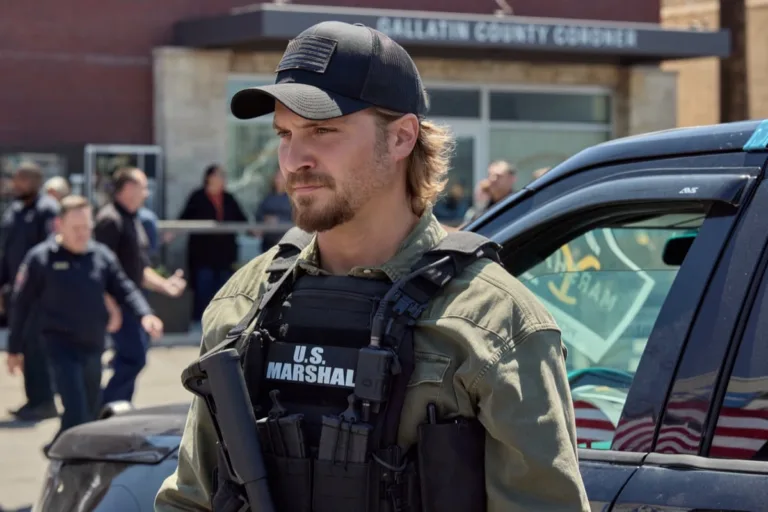
Marshals Season 2 Episode 2, “End of Watch,” asks whether protecting a family means controlling its future. A former officer’s revenge campaign supplies the immediate danger, while Kayce struggles with the aftermath of Tate’s kidnapping and Cal begins letting his colleagues into a crisis he cannot manage alone.
Luke Grimes leads the hour as Kayce Dutton, alongside Logan Marshall-Green as Pete “Cal” Calvin, Arielle Kebbel as Belle Skinner, Ash Santos as Andrea Cruz and Tatanka Means as Miles Kittle. Gil Birmingham’s Thomas Rainwater gives the episode its most useful perspective on the difference between guiding someone and deciding who they must become.
The following contains full spoilers for “End of Watch,” including the case’s resolution and Cal’s disclosure.
Our Season 2 premiere recap covered Tate’s rescue and Dolly’s death. This week returns to the team’s regular work, but the personal consequences of that rescue remain central.
Wayne Plummer Turns Grievance Into a Mission
Former SWAT officer Wayne Plummer targets people he blames for his ruined career. Belle encounters a pressure-triggered bomb at his home; Kayce gets her safely through it. The pursuit culminates in an ambush involving Wayne’s son. Harry Gifford survives a shot because of his vest, Wayne is killed, and his son surrenders.
The case is strongest as a study of grievance that cannot tolerate scrutiny. Wayne treats rejection as evidence of a campaign against him, making responsibility something other people must bear. A failed career becomes an injury demanding repayment. That mindset turns professional authority into a deeply personal claim: he believes the institutions that rejected him owe him the identity he wanted.
Bringing his son into the violence gives the story a sharper point than a list of revenge targets could provide. Family loyalty can become an obligation to preserve someone else’s account of the world. The son’s future matters because it is still possible to imagine one beyond his father’s anger.
The action moves briskly, sometimes at the expense of giving the investigation room to develop. The larger payoff is the distinction between understanding someone’s attachment to a parent and accepting the violence committed in that parent’s name. Kayce is well positioned to recognize that difference.
Cal Lets the Team Help, but Keeps One Door Closed
Cal tells his colleagues he has a rare form of lung cancer and faces chemotherapy, radiation and surgery. Maddie still does not know.
That uneven disclosure is more interesting than an immediate transformation into complete openness. Telling coworkers can mean explaining how a condition might affect shared responsibilities. Telling a daughter also means facing her fear and the possibility that she will see her father differently. The conversations ask different things of him.
Cal’s leadership has often depended on being the person who knows what to do next. Illness challenges that arrangement. He can organize an operation, but he cannot make certainty appear simply by speaking with authority. Accepting support requires him to allow other people into an experience he would prefer to keep contained.
The character gains depth from that tension. Disclosure does not erase competence; it changes what competence might mean. Preparation can include asking for help, and responsibility can include admitting that a team needs information before a crisis forces the issue.
Miles also finds his way back into field duty. It is a lighter development beside the episode’s heavier family material, but returning to the field should mean showing that he can work within the team’s trust rather than simply winning back access to the action.
Belle’s Family Has Its Own Claim on Her
Belle’s son Braxton needs reassurance after seeing her injured. He wonders why other parents do not get hurt at work, a question that makes her dangerous career painfully concrete. She returns to him rather than joining the team’s evening plans.
Her problem cannot be reduced to whether she wants a relationship with Cal. Work, parenting and intimacy require time from the same person, and a child’s fear does not wait for the adults to resolve their romantic lives. The episode benefits from allowing her home obligations to matter on their own terms.
There is also an uncomfortable limit to the reassurance a parent can offer. Belle can promise presence and care, but a dangerous profession makes an absolute guarantee difficult. Her situation complements Kayce’s without making their families interchangeable. Both need to help a child live with uncertainty while carrying uncertainty themselves.
Kayce Cannot Build His Way Out of Fear
Kayce adds surveillance at East Camp and hears Tate calling when no one else does. The new security cannot quiet his expectation of another emergency.
The contrast is useful because practical preparation and emotional recovery operate differently. Equipment can address a vulnerable property. It cannot automatically restore the feeling that ordinary life is safe. Kayce’s skill at responding to danger may even make waiting for the next threat feel more natural than resting.
Tate recognizes that Tom Weaver was dangerous, but still sees John Dutton as a good man. That distinction worries Kayce. His son can identify one threat without questioning the family history that made violence seem ordinary. The conversation at John’s grave, with Brecken Merrill as Tate, gives Kayce’s fear a specific shape.
Tate’s approaching 18th birthday adds urgency. Kayce has less time to influence him before adulthood brings greater independence, and another rescue will not necessarily change what Tate believes. A father can stop an immediate attack more readily than he can change the story his son tells himself about the men he admires.
Wayne’s son provides an unsettling counterpart. Loyalty can put a young man inside a conflict he did not create. His surrender offers a possibility Kayce needs to believe in: refusing a parent’s violence does not require denying every feeling of love or belonging.
Broken Rock’s Economic Anger Complicates Rainwater’s Leadership
Rainwater and Mo return to a community divided over the mine. Some residents blame Rainwater for the jobs they expected to gain and now will not have. Stopping a harmful development does not, by itself, replace the income people hoped it would provide.
That gives the dispute more substance than a simple choice between defending the land and accepting exploitation. Rainwater must answer a practical question about what comes next. His opponents can underestimate the mine’s costs while still expressing a real need for work and security.
Broken Rock deserves room for that disagreement to develop. The risk is that the reservation becomes a source of occasional pressure on Kayce instead of a community with decisions of its own. “Falling Sky” will return to the conflict next week; the stronger approach would let tribal leadership and residents retain agency within that story.
Rainwater Gives the Ending Its Direction
Rainwater reassures Kayce that caring about Tate’s future distinguishes him from John Dutton. He can guide his son without guaranteeing a life untouched by harm.
That offers a stronger answer than pretending the family name has stopped carrying weight. A legacy can shape expectations without determining every decision. Kayce has to examine what he learned, retain what helps and recognize what he should refuse to pass on.
His advice carries additional weight because he is facing criticism from his own community. Neither a father nor a leader can assume that good intentions settle every disagreement. Listening remains part of the work.
Final Verdict
“End of Watch” finds a coherent theme across its case and family stories: authority becomes dangerous when it cannot admit limits. Its most rewarding material allows the characters to consider what support might look like when control is no longer enough.
The manhunt’s pace leaves less space for the criminal story than the personal material receives. Still, Cal’s disclosure and Rainwater’s perspective give the hour a purpose beyond closing another case. Season 2 is more promising when the aftermath of danger changes how these people relate to one another.
A Son Can Choose Another Path
The case’s family conflict gives Kayce’s fears a useful counterpart, while Cal’s disclosure makes trust matter beyond the mission.
Rainwater helping Kayce distinguish guidance from control.
Logan Marshall-Green’s Cal, whose authority becomes more interesting when he accepts support.
The connection between family responsibility, inherited grievance and the limits of controlling risk.
The busy structure gives the manhunt less breathing room than the personal stories deserve.
End of Watch Ending Explained
Wayne dies, while his son is arrested rather than sharing his fate. Cal opens up to the team but has not told Maddie. Rainwater’s advice leaves Kayce with a task that extends beyond security: help Tate choose his own direction.
The ending offers progress without complete resolution. A case can end in one night; rebuilding trust within a family takes longer. The next challenge is whether the characters can act on what they have acknowledged.
SEAT42F • MARSHALS FAQ
Does Harry Gifford die?
No. His vest protects him during the ambush.
Who plays Cal’s daughter Maddie?
Morgan Lindholm returns as Maddie.
When is the next episode?
“Falling Sky” airs Sunday, October 18, 2026, at 8:30 p.m. ET/PT on CBS.
When Does Marshals Return?
Marshals Season 2 Episode 3, “Falling Sky,” airs Sunday, October 18, 2026, from 8:30–9:30 p.m. ET/PT on CBS. The next case involves a military drone crash and rising tensions at Broken Rock, while Kayce tries to connect with Tate.
Catch up through Paramount+. Premium subscribers can watch live through their local CBS feed and on demand; Essential subscribers can watch the following day. CBS’s “Falling Sky” announcement lists the episode-specific 8:30 p.m. start.
MORE MARSHALS COVERAGE
Follow Seat42F’s Marshals coverage, revisit our Season 2 premiere recap, and see the “End of Watch” photos and promo.

Thomas Miller is the founder and Editor-in-Chief of Seat42F, covering television, movies and streaming entertainment. He launched Seat42F in 2007 and has spent nearly two decades covering the entertainment industry.