Last Seen arrives on Apple TV with a premise that initially sounds very familiar: a child disappears, a family is destroyed and, years later, one unexpected development reopens a mystery everyone else had learned to live with.
What separates the six-episode Australian thriller through its first two episodes, “The Dispatcher” and “The Call,” isn’t necessarily the mystery itself. In fact, Last Seen is surprisingly willing to show viewers where at least part of this story appears to be heading. Instead, the premiere works because Patrick Brammall makes Ian Ridley’s inability to let go feel painful, dangerous and completely understandable.
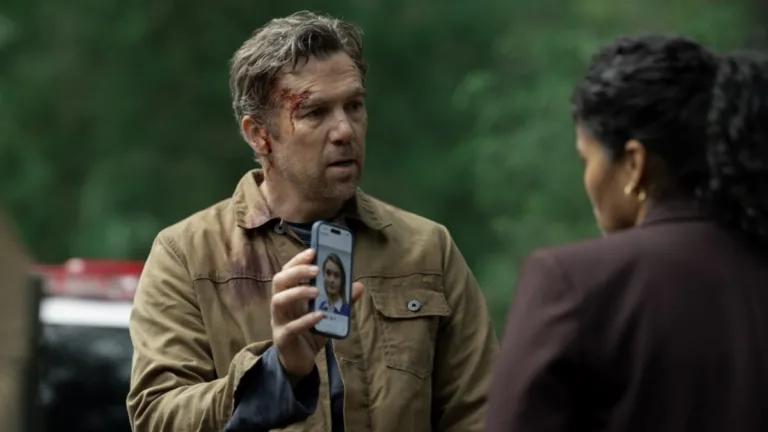
Adapted by Kris Mrksa from Ryan David Jahn’s novel The Dispatcher, Last Seen begins 11 years after Ian’s three-year-old daughter Maggie disappeared from her home. Once a police detective, Ian now works as a 000 emergency dispatcher, is six months sober and remains trapped in a past that everyone around him has tried, with varying degrees of success, to survive.
This review discusses major plot developments from Last Seen Episodes 1 and 2, including the ending of “The Call.”
Last Seen Episodes 1 & 2 Review
The discovery of a young child’s remains in the woods following a storm is exactly the kind of development that can destroy whatever fragile progress Ian has made. The age of the child and how long the remains have been buried immediately suggest the possibility that police have finally found Maggie.
For Ian’s ex-wife Debbie, played by Jessica Wren, that possibility could finally provide an ending to an 11-year nightmare. Ian responds differently. He inserts himself into the investigation, follows every possible clue and eventually falls back into drinking. Even before Last Seen gives Ian a reason to believe Maggie might still be alive, Brammall makes it clear that this is a man who never truly accepted that she was dead.
That distinction matters. Ian’s refusal to let go can look like devotion in one scene and self-destruction in the next. He attacks an abusive man after encountering his case through the emergency line, pushes against the people trying to help him and remains capable of hurting those closest to him when his obsession takes control.
Brammall is excellent at keeping those contradictions together. Ian doesn’t need to be particularly likable for us to understand him. His anger, guilt and desperation all come from the same place, and the performance prevents the character from becoming another generic grieving father turned vigilante.
The Maggie Mystery Isn’t Really the Point
The biggest gamble Last Seen makes is how quickly it appears to show its hand.
Running alongside Ian’s story is the life of teenager Sarah, played by Chloe Jean Lourdes, who lives on an isolated farm with Henry and Jenna Reid, played by Brendan Cowell and Maxine Peake. Sarah has been raised largely apart from the outside world, while Henry’s elaborate security precautions and hostility toward outsiders immediately make the family’s situation feel wrong.
Then Last Seen begins dropping clues that aren’t particularly subtle. Sarah is the age Maggie would now be. She resembles the age-progressed image of Ian’s missing daughter. She has fragments of memories she doesn’t understand, including the name “Mags.”
A more conventional mystery series might spend four episodes asking viewers whether Sarah could really be Maggie. Last Seen seems much less interested in playing that game.
That’s potentially one of its smartest decisions.
By the end of these opening episodes, the more compelling questions aren’t simply whether Sarah is Maggie. They’re how she ended up with Henry and Jenna, what really happened 11 years ago, who else knows the truth and what Ian will do once hope replaces grief as the force driving him forward.
Brendan Cowell and Maxine Peake Make the Reids More Than Obvious Villains
It would be easy for Henry and Jenna to function only as giant flashing warning signs, particularly once Sarah’s connection to Maggie becomes increasingly difficult to ignore.
Cowell and Peake make them more unsettling because neither plays the situation quite that simply. Henry is controlling and deeply suspicious of the outside world, while Jenna carries her own unease about the life they’ve constructed. Their isolated home, religious worldview and efforts to keep Sarah separated from modern life create an atmosphere where almost every ordinary interaction feels slightly threatening.
Chloe Jean Lourdes also has difficult work to do as Sarah. She needs to seem sheltered without becoming naive to the point of caricature, and the second episode gives her character considerably more agency as curiosity begins overpowering the fear that has kept her contained.
Episode 2 Turns Last Seen Into a Different Kind of Thriller
“The Call” is where the premiere really clicks.
Police determine that the remains found in the woods are not Maggie’s. Suddenly Ian’s refusal to believe his daughter died no longer looks quite as irrational as everyone assumed.
At the same time, Sarah starts investigating her own past. A flyer about Maggie, her memory of carving “Mags” into a tree and the increasingly suspicious behavior around her push Sarah beyond the boundaries Henry and Jenna have built around her.
Her escape with Tommy briefly exposes her to a world she barely understands. The trip goes badly, but it ultimately gets Sarah to a phone booth, where an instruction to dial 000 in an emergency creates the coincidence on which the entire premise turns.
Ian answers.
It’s an enormous coincidence, and Last Seen doesn’t entirely escape the contrivance required to make it happen. But Brammall and Lourdes sell the moment well enough that the emotional payoff overwhelms most of the mechanical objection.
When Sarah first gives Ian her name and then says that maybe she’s “Mags,” everything changes.
For 11 years, Ian has survived on little more than the belief that Maggie could still be alive. Now a frightened teenage girl has called his emergency line and given him exactly the words he has been waiting more than a decade to hear.
Last Seen Works Better as a Character Drama Than a Puzzle
There are reasons to be cautious about where Last Seen goes from here. Missing-child thrillers are hardly rare, and some of the plotting already depends on convenient intersections between characters. Viewers looking for a mystery built around impossible-to-predict twists may also find the early Sarah revelations surprisingly transparent.
But those aren’t necessarily fatal problems because the first two episodes suggest Last Seen understands its strongest material isn’t the puzzle.
It’s Ian.
The series is more interesting when asking what unresolved grief has done to him than when asking viewers to identify a kidnapper. Even the discovery that the body isn’t Maggie’s doesn’t provide relief. It gives Ian something potentially more dangerous: hope.
Christian Schwochow’s direction and the muted Australian setting give the series the polished, atmospheric look expected from an Apple TV drama, but the performances keep that polish from making the story feel sterile. Brammall is the standout, with Cowell, Peake and Lourdes giving the other half of the story enough weight that Ian isn’t carrying the entire series alone.
Final Verdict
Last Seen doesn’t reinvent the missing-child thriller in its first two episodes, and its central mystery may be considerably easier to read than the series initially suggests. That turns out to be less damaging than expected.
By shifting attention away from simply asking whether Sarah is Maggie and toward how these two families became connected, Last Seen creates a more emotionally interesting mystery. Patrick Brammall gives the premiere its bruised, volatile center, while the final moments of Episode 2 transform Ian’s decade-long obsession into something much more powerful.
For the first time in 11 years, Ian doesn’t merely believe Maggie could be alive.
He has heard her voice.
Last Seen Episodes 1 & 2
A familiar missing-child mystery becomes something more compelling by putting grief, obsession and dangerous hope ahead of the puzzle.
Sarah tells the 000 dispatcher that maybe her name is “Mags” — without initially realizing the man on the other end is Ian.
Patrick Brammall, who makes Ian’s grief, anger and obsession feel like different expressions of the same wound.
Strong performances and the decision to make Sarah’s identity less important than understanding how she ended up with the Reids.
Some major developments rely on convenient coincidences, particularly the phone call that connects Sarah directly to Ian.
Last Seen Episode 2 Ending Explained: Is Sarah Really Maggie?
The ending of Last Seen Episode 2 gives Ian his strongest reason yet to believe that Maggie survived her disappearance 11 years ago.
After Sarah begins questioning what Henry and Jenna have told her about her life, memories and clues increasingly connect her to Maggie. Most importantly, she remembers the name “Mags,” the nickname Ian used for his daughter.
Sarah eventually reaches a phone booth and calls Australia’s 000 emergency service. By extraordinary coincidence, Ian answers the call. Sarah initially identifies herself by the only name she has known before telling him that maybe her name is Mags.
Ian immediately believes he could be speaking to his daughter and rushes to reach her. By the time he arrives at the phone booth, however, Sarah is gone.
The episode stops short of definitively resolving Sarah’s identity, but that’s increasingly beside the point. Ian now has something far more powerful than another clue: he has heard the voice of a girl who independently connected herself to the name Mags. Episode 3 can therefore move the mystery away from whether Maggie might have survived and toward what happened to her, how the Reids are involved and whether Ian can find Sarah before she disappears again.
When Does Last Seen Episode 3 Premiere?
Last Seen Season 1 Episode 3, “The Lie,” premieres Wednesday, September 16 on Apple TV. The six-episode season continues with one new episode every Wednesday through October 7.
Catch up on more Last Seen news, episode recaps, reviews, photos and coverage from Seat42F.
See all Last Seen coverage →

Thomas Miller is the founder and Editor-in-Chief of Seat42F, covering television, movies and streaming entertainment. He launched Seat42F in 2007 and has spent nearly two decades covering the entertainment industry.