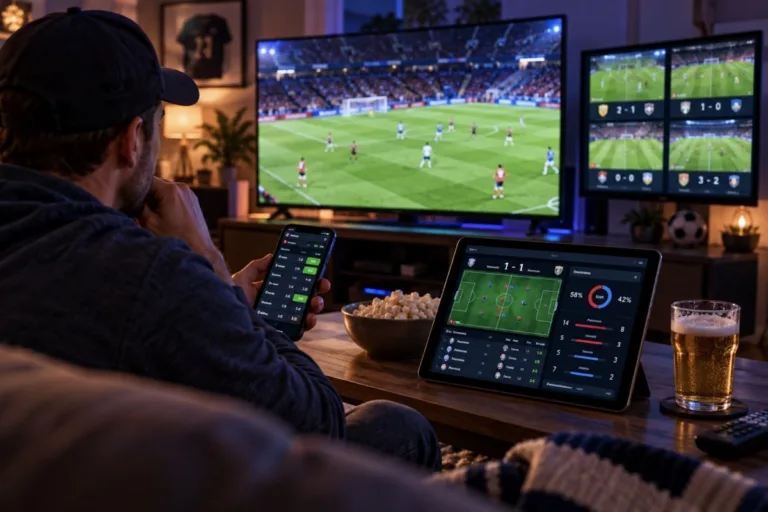
Watching sport used to leave quite a lot to the imagination. You had the score on television, perhaps a few statistics at half-time, and whatever the commentator happened to mention. If you wanted to know how many shots a team had taken or whether a player had been substituted in another match, you often waited until someone on the broadcast told you. That feels surprisingly distant now. During major events, supporters can have the match on one screen while another shows possession, shots, line-ups, player numbers and updates from games happening somewhere else.
It has changed the way people read sport. A football match can still be 0-0, yet the numbers may show one team spending twenty minutes camped around the opposition penalty area. In tennis, the score tells only part of the story if one player is suddenly struggling to land a first serve. During a basketball tournament, foul trouble or a run of turnovers can explain why a game that looked comfortable has started to shift. Live data gives viewers another way into what they are already watching rather than replacing the match itself.
That extra layer has also become closely tied to sports betting. People who follow online betting no longer have to make every decision before kickoff and then wait for the result. Markets can move with what is happening on the field, which means anybody looking to place a bet during the game is reacting to a much fuller picture than the score alone. On a platform such as Betway, the option to place a sports bet sits alongside live information and changing markets, making the relationship between the broadcast and the second screen much more obvious than it was when betting was mainly something done before matchday began.
In football, expected goals, shots on target and possession have become familiar even to people who would never describe themselves as statistics obsessives. In baseball, basketball and cricket, the numbers go much deeper because the sports have long been comfortable with detailed records. Live events now produce an almost continuous stream of information, and viewers have learned which bits they care about and which they can safely ignore.
Betting followed the same move toward real time
Pre-match sports betting has not disappeared, but live markets changed the pace of the experience. Someone may place a bet before the first whistle because they have spent the week reading team news. Another person may wait twenty minutes, watch how the game actually develops and then decide whether anything interests them. Both are using information, but the second decision depends much more heavily on what the live feed is showing.
This is where online betting and live data became difficult to separate. Odds can react to goals, cards, injuries, substitutions and the remaining time. The tech behind the platform has to receive those changes quickly enough for the market to remain relevant.
That does not mean every statistic becomes useful. A team can dominate possession and still create almost nothing. Five corners do not automatically mean a goal is coming. Numbers need context, which is one reason the actual match remains so important.
On a busy matchday, especially when several matches overlap, the data is often most useful as a way of deciding where to look. A sudden red card in one game, an injury in another or an unexpected scoreline somewhere else can pull attention away from the match that originally seemed most interesting. For people following several sports bets, that ability to move between games has become part of the experience.
One tournament can create a huge amount of information
Big international events make the change particularly visible. During a long football tournament, there may be multiple matches on the same day, changing group tables, qualification permutations and players carrying yellow cards from one round to the next. Nobody is going to keep all of that in their head.
The second screen does the remembering. A fan can check standings while watching, see which team would qualify if the score stays the same and then jump back to the game. Someone interested in sports betting may be looking at similar information for a different reason, particularly before deciding whether to place a bet on a later fixture.
The useful part is that the same raw data can serve very different people. One supporter wants to know whether a striker has had a shot. Another has a fantasy team. Someone else follows online betting, while another simply wants to know why the commentator keeps saying the next goal changes the entire group. Good tech does not force everyone into the same view; it lets them pick the information that matters.
That becomes even more important late in a tournament, when matches can influence one another. At that point, live tables and score alerts are not really optional extras. They are part of understanding the events themselves.
Outstanding online betting design therefore has a lot in common with good sports broadcasting. Both have to decide what deserves attention. The best tech often does less than people imagine. It updates quietly, keeps the screen readable and makes sure the information is there when somebody wants it.
The match still comes first
Live data has changed sport, but it has not made the old experience obsolete. People still shout at a missed chance without checking the expected-goals figure first. A late winner still feels like a late winner whether or not an app explains how unlikely it was. The numbers are useful because they sit beside the game, not because they replace it.
That is also the healthiest way to look at sports betting and online betting around live sport. The match provides the drama. Data adds context, while sports bets are another optional way some viewers choose to engage with what they are watching.
On any given matcheday, someone may check five statistics and never place a bet at all. Another person may follow several events and use the same information differently. The important change is that both now have access to details that once belonged mainly to commentators, analysts and professional desks.
As the tech continues to improve, there will inevitably be more numbers, faster updates and new ways to follow a tournament. Yet the most useful live data will probably remain the information that answers a very simple question at exactly the right moment: what is happening in this game right now?

Thomas Miller is the founder and Editor-in-Chief of Seat42F, covering television, movies and streaming entertainment. He launched Seat42F in 2007 and has spent nearly two decades covering the entertainment industry.