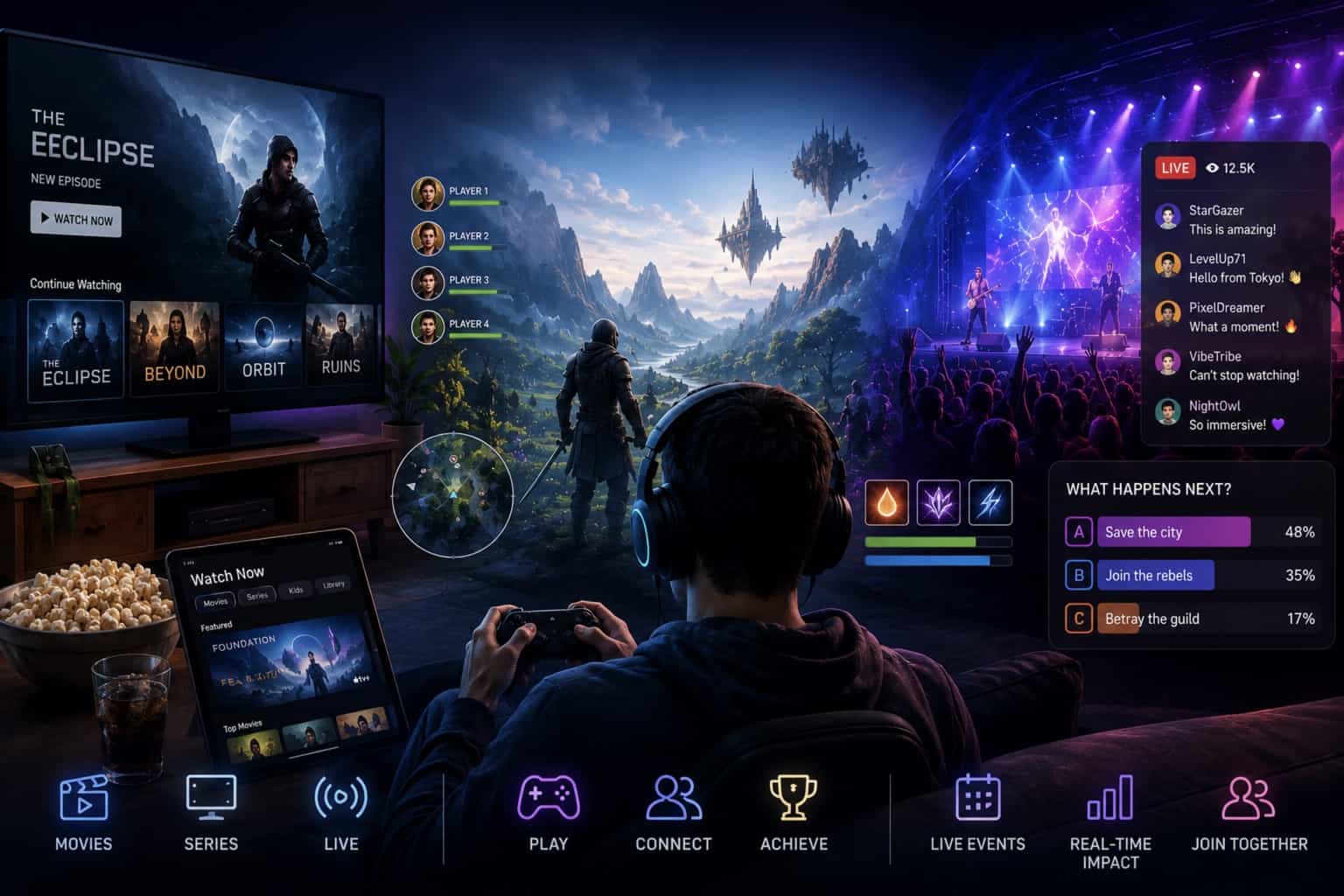
Lines are increasingly being blurred between television, video games and live digital experiences. Once separate channels of distribution for separate forms of entertainment, they are now slowly being brought together under a number of platforms. Audiences may be adapting at a rate that even the biggest industry analysts are struggling to keep up with.
Convergence is reshaping how content is built and consumed
The transition to participatory media is not a trend which is developing gradually, but rather a structural change which is occurring with ever greater speed. Audiences increasingly expect content that responds to them in real time, a shift visible across sectors from interactive film to playing live dealer blackjack in the UK, where broadcast-quality production meets moment-to-moment player decisions in ways that traditional television never attempted. Many platforms have started to experiment with branching narratives, such as Netflix, but other platforms such as Twitch have already normalized audiences influencing a live broadcast with commands in chat or real-time voting. This is how content is becoming a two-way relationship.
According to the Reuters Institute’s Digital News Tracking of consumption trends, the young prefer to spend their time with more interactive, short-form content rather than with traditional scheduled TV. Consequently, many producers are already building in audience choice from the start rather than trying to add it later.
Technology is enabling experiences that were not previously possible
The cloud, low-latency streaming and a host of new, powerful and connected devices are removing many of the key barriers to convergence between streaming and gaming. Research into the future of creative industries by NESTA identifies real-time interactivity as the key defining feature of the next phase of digital entertainment innovation, with streaming at its heart.
The UK’s rules on the regulation of interactive entertainment are changing. An immersive technologies inquiry has been undertaken by the UK Parliament to consider issues around responsibility in relation to hybrid products offered through various platforms that typically serve largely passive content but also include interactive elements.
What this means for audiences and platforms
Notice from reading Seat42f reviews & coverage of films and TV shows that the production values of such content to be interactive is rising sharply, with TV drama budgets now being translated into live & hybrid format productions for the interactive viewer. TheHouseofCommonsLibrary has published a new briefing that explores the evolution of the streaming market and how investments are tracking to viewer attention, with a shift to ‘live’ formats that allow for a more interactive and ‘present’ viewing experience as opposed to the traditional passive viewing model.
As platforms increasingly combine monetization, moderation and design, they face real challenges in these areas. The fact that platforms now exist in real-time media makes a number of issues around issues of consent, data and user experience that didn’t apply to static, published content, suddenly apply.
A structural shift, not a temporary experiment
Contrary to the belief that Interactive entertainment is becoming a niche growing from the margins of the wider Interactive entertainment market, Interactive entertainment may be fast becoming the default form of experience for an increasing share of digital audiences. For platforms, studios and for regulators, all this Interactive entertainment may be forcing the development of new frameworks, possibly as malleable as the content itself.

Thomas Miller is the founder and Editor-in-Chief of Seat42F, covering television, movies and streaming entertainment. He launched Seat42F in 2007 and has spent nearly two decades covering the entertainment industry.